A reel landed in a group chat I’m in. You know the sort by now, because this series started with one: an AI-generated girl, some engineered outrage, a caption doing three jobs at once. A friend had posted it with a couple of crying-laughing faces. Two other people had already replied with more of the same.
I typed: that’s AI, and it’s a bit racist honestly.
Then I looked at it sitting in the box, unsent, and I deleted it. Then I typed it again. Then I sat there while the little dots showed someone else typing, and I nearly deleted it a second time, because sending it meant being the person who killed the joke — the one who couldn’t just let a laugh be a laugh, the wet blanket, the actually guy. I sent it anyway, mostly out of spite at myself for hovering.
Nothing happened. That’s the whole story. One person replied “lol true,” the chat moved on to football within ninety seconds, and the world did not end. The entire cost of the thing I’d been dreading was about eight seconds of social exposure and a very mild fear of being uncool. The entire content of the brave act was one sentence that annoyed no one.
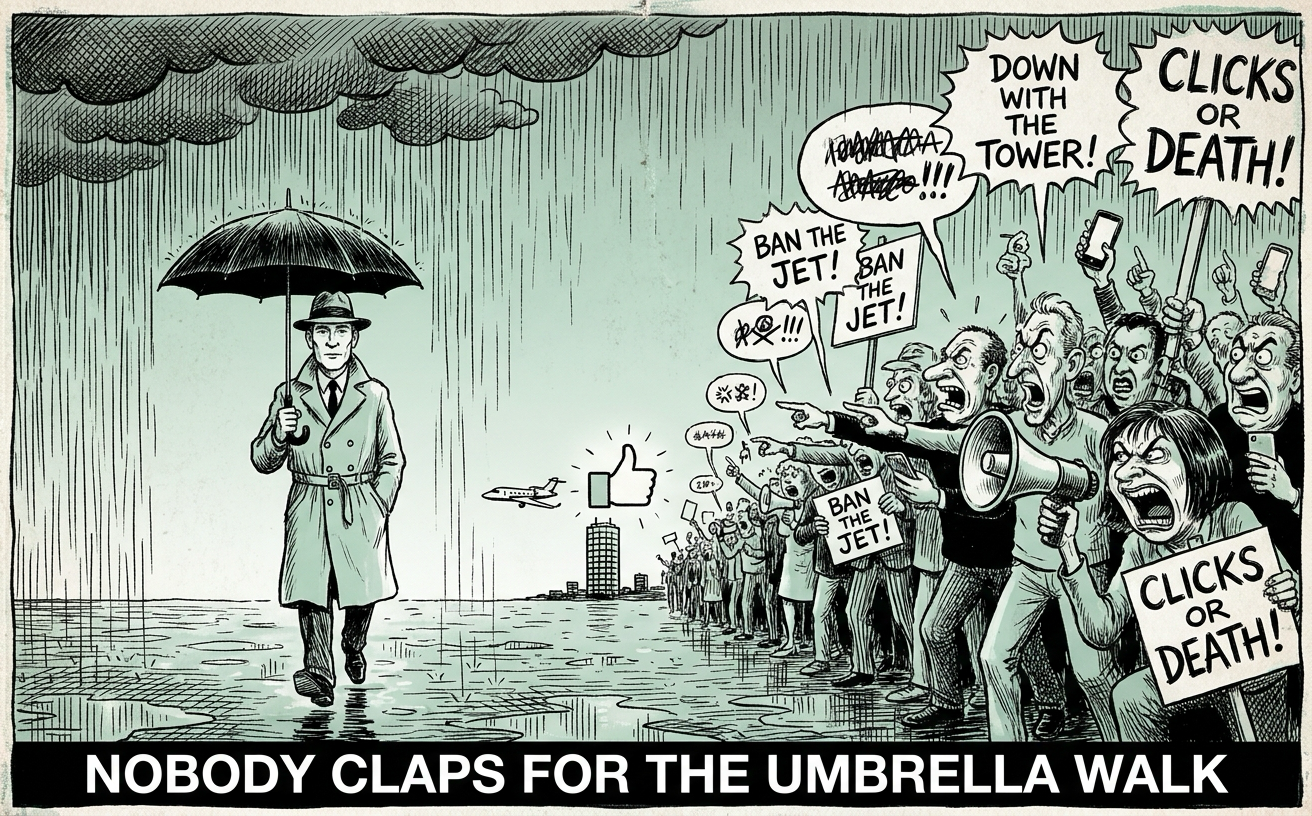
This is the last piece in The Umbrella Walkers, a series about misdirected moral attention. The first four were diagnosis. The Polish Influencer Who Doesn’t Exist — the AI account we wanted the platform to ban. The Climate Elon Trap — the billionaire’s jet we loved to hate. The Villain at the End of Your Road — the flats we let die. Those People — the category we poured our contempt into. Four different subjects, one identical disease: outrage aimed at a named, distant, satisfying target, which feels moral and does nothing. This one is about the cure. And the cure turns out not to be a better argument. It’s a muscle. Let me show you where it is and how to train it, because I have been rubbish at using mine and I think I finally understand why.
I. The one disease, named once
Put the four cases in a row and the shape is unmistakable.
The influencer. We wanted Instagram to ban her. Named target, distant, satisfying, useless — she’s back by lunch. The lever was the group chat.
The jet. We raged at the billionaire while taking the car. Named target, distant, satisfying, useless — his plane is a rounding error. The lever was the norm you set walking to the station.
The flats. We blamed oligarchs and boomers while the objection letters piled up. Named target, distant, satisfying, useless — the homes died at the parish meeting. The lever was the letter of support you were too embarrassed to write.
The category. We despised “gammon” and “chav” from the safety of a group that can’t answer back. Named target — a whole face-shaped hole of them — distant, satisfying, useless, and it hardens the very thing it hates. The lever was the one real person at your own table.
Same disease every time. And the inversion that runs under all four is this: the thing standing between us and the lever was never ignorance and never a lack of laws. It was that the correct action is socially awkward and yields no reward — and we have quietly trained ourselves to only do the things that reward us.
We know what works. Everyone, told plainly, agrees that the group chat matters more than the platform, that norms shift votes, that minds change at kitchen tables. The knowledge was never the bottleneck. The bottleneck is that the effective action is small, unglamorous, socially expensive and completely un-clappable, while the ineffective action — the post, the rage, the screenshot, the sneer — is large-feeling, safe, and applauded. We are not stupid. We are incentivised, exquisitely, toward the version of caring that changes nothing.
The umbrella walk doesn't fail because it's hard. It fails because it's embarrassing and nobody claps.
II. The counter-argument, which could sink the entire series
Before I tell you how to train the muscle, I have to face the objection that has been building for four essays, because if I can’t answer it, everything above is worse than useless — it’s an instruction to fiddle with your dinner table while the world burns.
The objection: this is quietism dressed as wisdom. You have written four pieces telling people that the answer to the climate emergency, the housing catastrophe, and organised bigotry is to be a bit nicer in their group chat. That is precisely the depoliticising move that power adores — take structural problems, ones that need taxes and laws and mass movements and confrontation with actual interests, and dissolve them into a matter of personal conduct and individual virtue. Tell people to fix their own small circle and they will feel morally busy while the fossil-fuel companies drill, the landlords extract, and the state cuts. “Walk in the rain” is the most convenient possible politics for the people who’d like you to do nothing that costs them anything. You’ve spent a series disarming your own readers.
That is the strongest thing anyone can say against this series, and I have thought about it more than any other sentence in it. Here is the answer.
The small-group tier is not the alternative to structural change. It is the substrate structural change grows in, and there is no other soil.
Every large lever the objection wants us to pull — the carbon tax, the planning reform, the mass movement, the redistributive government — runs through the ballot box or the street, and both of those are downstream of what a critical mass of people find normal, sayable, and true. No carbon tax survives a public that thinks flying to Prague for a stag do is a human right. No planning reform survives a country where every proposed home dies to a Facebook group. No anti-racist politics wins in an electorate that’s been hardened into caricature by the contempt of the people who claim to oppose racism. The structural change the objection demands does not float free above the kitchen table. It is rooted in it, or it doesn’t take.
Which means this series is not an argument against politics. It is an argument against the fake politics we’ve substituted for the real thing — the jet-rage, the oligarch-blame, the “gammon” screenshot — all of which feel intensely political and are, functionally, the opposite: a way of discharging political energy so completely that none of it reaches the tier where politics is actually seeded. The distant target isn’t the radical option and the group chat the timid one. It’s the reverse. The distant target is the safe, applauded, structurally inert performance. The group chat is where you pay a real cost to move a real thing.
So: vote. March. Organise. Confront the actual interests. None of that is in tension with a single word of this series — all of it is the umbrella walk at civic scale, the same muscle used on a bigger frame. What this series is against is mistaking the feeling of the march for the march, and there is a lot of that about.
III. The muscle, and how to train it
If the cure isn’t knowledge, and it isn’t laws, and it isn’t a better argument, then it’s a capacity — the capacity to do the effective thing precisely when it’s awkward and unrewarded. That’s trainable. Here’s the training, drawn from the wreckage of my own four attempts.
First: learn the tell. The disease has a signature, and once you can feel it you can’t unfeel it. The tell is the surge of clean, uncomplicated righteousness aimed at someone who cannot answer you back. If the target is far away, famous, or an abstraction; if being angry at it costs you nothing; if a crowd is ready to applaud the anger — you are in the trap. Real levers don’t feel like that. Real levers feel awkward, local, and slightly embarrassing. The rule of thumb: if the outrage is comfortable, it’s probably the wrong one.
Second: redirect the same energy to the nearest tier where you actually have standing. Don’t kill the anger — spend it somewhere it can do work. The jet becomes the car you don’t take. The oligarch becomes the flats you back at the meeting. The category becomes the uncle you stay at the table with. The platform ban becomes the sentence in the group chat. Same fuel, moved from the tier where it evaporates to the tier where you have leverage — which is, always, the small group you’re actually a member of.
Third: pay the awkwardness tax, out loud. This is the whole muscle and everything else is warm-up. The effective action is nearly always the one with a small, immediate social cost — being briefly uncool, briefly the difficult one, briefly the person who couldn’t let it go. That cost is the price of the lever, and the reason the lever sits unused is that almost nobody will pay eight seconds of mild social exposure for a thing that wins them no applause. Pay it. It is smaller than it looks from the inside, every single time. The dread is enormous and the actual bill is loose change.
Fourth: set the norm, don’t just hold the virtue. This is what saves the whole thing from being the private-virtue trap the climate piece warned about. The point is never your own clean footprint, your own un-forwarded screenshot, your own private correctness. Those are worthless alone. The point is that you do it visibly, in front of the small number of people for whom you are one of the data points that sets what’s normal. Private goodness is the BP trap — a spotless footprint nobody ever copies. What you’re after is the baseline of the six people who’ll copy you without noticing, and that baseline only ever moves in public.
Fifth: expect no applause, and check for it. If you find yourself doing the small brave thing in a way that’s engineered to be seen and admired by the wider crowd — posted, performed, screenshotted for credit — you’ve quietly slid back into the distant-target game, just with yourself as the hero. The umbrella walk has no audience beyond the handful of people physically near it. The absence of applause isn’t a bug in the method. It’s the proof you’re using it.
The two versions of caring
The performance
Aimed at the distant target. Feels enormous, costs nothing, wins applause, changes nothing, and often hardens the thing it hates. The march you felt instead of marched.
The muscle
Aimed at the nearest tier you belong to. Feels tiny, costs a flash of social exposure, wins no applause, and is the only place norms — and therefore votes, and therefore structures — actually move.
IV. Why it’s this small on purpose
There’s a reason the lever keeps turning out to be this modest, and it’s not that big change doesn’t matter. It’s that big change is a stack of small changes wearing a coat, exactly as the hundred emitting companies turned out to be a billion car journeys wearing a corporate coat.
A norm is not a thing a government installs. It’s the emergent sum of what millions of people, in millions of small groups, treat as normal — and each of those small groups is moved by its own handful of members doing the visible, awkward, unrewarded thing. Scale a hundred million umbrella walks and you get a shifted norm; shift the norm and the carbon tax becomes electable; make it electable and the structure changes. The chain runs from the group chat to the statute book, and it only runs in that direction. There is no shortcut that skips the group chat. The distant-target performance is the shortcut everyone takes, and it dead-ends, every time, in a feeling.
That’s why four essays about billionaires, housing policy, and organised prejudice keep collapsing back to the same unglamorous instruction: say the awkward thing to the people in the room. Not because the room is where the problem is. Because the room is the only place you have any actual power, and power spent where you have none is just theatre you’re performing for yourself.
V. Back to the group chat
I’ve spent this whole series confessing to hills I didn’t climb. The car I took. The letter I didn’t write. The friend I never corrected. That was honest, and it was also the point — the muscle is weak in me too, and pretending otherwise would have made this a lecture instead of a report from someone doing badly at the same thing as you.
But I did send the message. One sentence, into one group chat, at a cost of eight seconds and a flicker of dread, changing — as far as I can measure — nothing at all. Nobody’s mind visibly moved. There was no applause, because there was no audience beyond four people and a football score.
And yet it’s the truest thing I did all month, because it’s the only thing I did that a distant target couldn’t absorb for me. The billionaire couldn’t take that eight seconds off my hands. The oligarch couldn’t. “Gammon” couldn’t. Only I could send it or not send it, in a room where I actually had standing, at a cost only I could pay.
That’s where the whole series has been walking to. Not the platform, not the jet, not the villain at the end of the road, not the category. The room you’re already in, the people who’ll actually copy you, and the small awkward sentence nobody will thank you for.
Send it. Then send the next one. The muscle is real, it’s weak in all of us, and it only grows the one way muscles grow — under load, with nobody watching, hurting slightly, again tomorrow.
The Bottom Line
Five essays, one disease: we aim our outrage at named, distant, satisfying targets because it feels moral and costs nothing — and changes nothing.
The cure isn't a better argument or a better villain. It's a muscle: the willingness to do the small, awkward, unrewarded thing in the one room where you actually have standing, in front of the handful of people who'll copy you without noticing.
It's embarrassing. Nobody claps. The bill is always loose change and the dread is always enormous.
Spend your outrage where you have standing, pay the eight seconds, and expect no applause. That, multiplied by everyone, is the only thing that has ever moved.
This is the fifth and final piece in The Umbrella Walkers — a series on misdirected moral attention, atrophied small-group accountability, and where culture actually changes. It began with an AI influencer who doesn’t exist and ends in a group chat that does. This piece carries no new statistics by design; every factual callback — the jet as a rounding error, the homes that die at the parish meeting, the contempt that hardens the thing it hates — is sourced in the four essays before it, drawing on the FBI’s IC3 reports, the Office for Budget Responsibility, ONS wealth data, the Trussell Trust, and the outrage-and-virality research of Brady, Crockett and colleagues (PNAS, 2017; Science Advances, 2021). The interpretations — and the hills I still haven’t climbed — are my own.