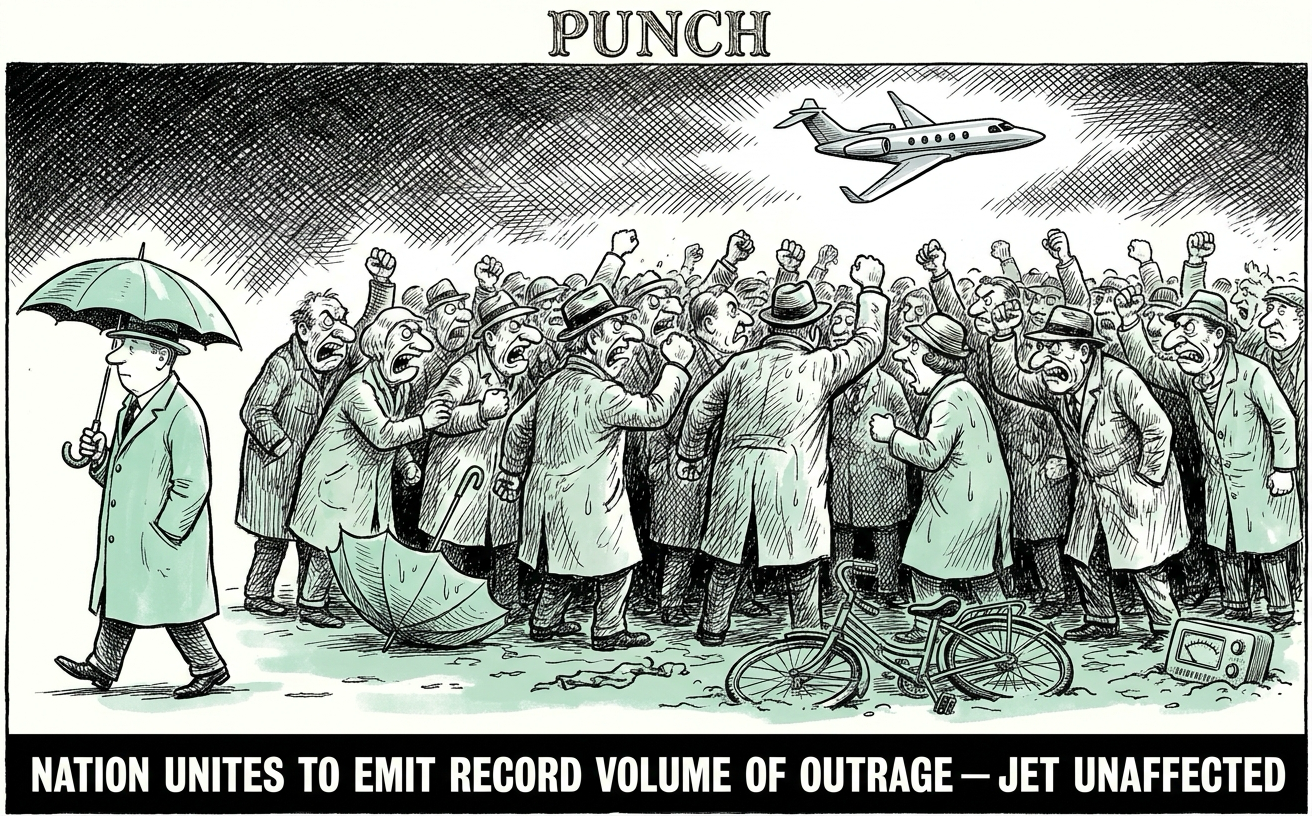
There is an account I follow that tracks a billionaire’s private jet. Every time the plane takes off it posts the route, the flight time, and an estimate of the carbon it burned — usually rendered as some satisfying multiple of what a normal person emits in a year. Eleven minutes in the air. Forty-two years of your recycling. That kind of thing.
I was reading one of those posts on my phone, standing in my own hallway, with an umbrella in my hand, deciding whether to walk fifteen minutes to the station in the rain or just take the car.
I took the car.
And somewhere over the next junction it landed on me that these two things were not unrelated. The rage at the jet and the decision to drive were not opposites. They were the same act. Being properly, righteously furious at a man burning a year of my emissions in a morning is exactly the feeling that let me, thirty seconds later, feel far too morally clean to get wet. I had already done my bit. I had been angry at the correct person.
This is the second piece in a series about misdirected moral attention — about the gap between where we aim our outrage and where the actual lever sits. The first was about an AI influencer, and the instinct to demand the platform ban her. This one is about the biggest version of the same mistake we have. And I want to be honest that I am the mark in this one, not the analyst. Let me show my working.
I. The trap, named
Here is the inversion, stated plainly so you can argue with it for the rest of the piece. Being furious at the billionaire’s jet is not the beginning of climate action. It is the substitute for it. The rage feels like the first rung on a ladder. It is actually the whole staircase, and it goes nowhere.
Call it the Climate Elon Trap, because Elon is the purest specimen — named, gigantic, genuinely doing damage, and above all satisfying. But the trap does not need a billionaire. It works just as well pointed downward. The same person who rages at the private jet on Monday will, on Tuesday, roll their eyes at the family on the £29 Ryanair flight to Alicante — the “cheap flights are killing the planet” crowd, sneering at people whose entire annual carbon budget wouldn’t fuel one of Taylor Swift’s taxis to the airport.
Up at the jet, down at the budget holidaymaker. Both directions do the identical thing: they find a named, distant, morally legible target, generate a clean hit of superiority, and change precisely nothing about the emitting. The jet-tracker and the budget-flight-sneerer are the same person wearing different coats.
The reason this matters is arithmetic, and the arithmetic is brutal.
II. The cold hard data
Start with the jet, since that is where the attention goes. Add up every private jet flight on the planet — all of them, the whole global fleet, all year — and the total is a rounding error against global emissions. In 2023 the entire world’s private-jet fleet put out around 15.6 million tonnes of CO2. Set that against global emissions of roughly 37 billion tonnes and you get about four-hundredths of one percent. Private jets are grotesque per passenger — they serve perhaps 256,000 people, around 0.003% of the world’s adults. They are also, in aggregate, almost nothing, because there are almost none of them.
Aviation as a whole — every commercial flight, every holiday, every business trip on Earth — comes to about 2.5% of global CO2, roughly a billion tonnes a year. The private slice of that couple of percent is the thing we spend most of our climate anger on.
Now the other end of the scale. Somewhere around 60% of global emissions are driven by household consumption — what ordinary people heat, drive, eat, buy and throw away. Not billionaires. Not a cabal of a hundred men. Households: billions of them, making billions of small decisions a day.
The distribution is savagely unequal, and this is the part the jet-people are half-right about. The global top 10% of earners produce nearly half of all emissions — about 48% — while the poorest half of humanity account for barely a tenth. But here is the sting: if you are a comfortable person in Britain reading this on a device, you are, globally, in that top 10%. That decile is 782 million people; it extends well beyond the super-rich and deep into the ordinary British middle, and UK consumption emissions run at roughly double the world average. The jet is a distraction from the mirror. When we say “the rich should fly less,” the rich, on the only scale that counts, includes almost everyone who has the leisure to be angry about it.
And the behavioural lever is real, not sentimental. The IPCC’s own Sixth Assessment says demand-side changes — how people move, heat, and eat — could cut emissions in those end-use sectors by 40–70% by 2050, and it says so with high confidence. That is not the fringe hippie position. That is the consensus scientific body saying the umbrella walk, multiplied, is one of the largest available levers on the board.
III. Why the jet is so much more fun to hate
The reason we aim at the jet and not the mirror is not stupidity. It is that the jet is built to be hated, and the mirror gives you nothing.
Outrage at a named target is emotionally complete in itself. It resolves. You see the jet post, you feel the surge, you quote-tweet it, you are done — you have discharged the feeling and can move on with a clean conscience. The literature on this is unkind. Moral-emotional content spreads further and faster: in a landmark study of half a million tweets, each moral-emotional word in a post lifted its reach by around 20%. The sharing is where the energy goes. The follow-through — the boring, effortful, personal-cost part — mostly does not happen: a 2026 study of online petitions found that moral outrage predicted how far a petition travelled but not how many people actually signed it. We share the rage. We do not sign up. We definitely do not walk in the rain.
The umbrella walk is the exact inverse. It generates no post. Nobody sees it. There is no villain to point at, no surge, no resolution — just you, damp, having saved an amount of carbon so microscopic it rounds to zero on any chart you could draw. Every single incentive that the jet-post satisfies, the walk denies.
So we do the thing that feels like action and skip the thing that is action. This isn’t hypocrisy — hypocrisy would require knowing better. It is a straightforward response to which behaviour pays out in feeling and which does not.
The jet gives you the full hit of moral action for none of the cost. That is not a side-effect of the outrage. That is what the outrage is for.
IV. The counter-argument, which is better than mine
Now the objection, and it is a serious one — serious enough that if I can’t answer it, the whole piece collapses into exactly the smug individualism it claims to be against.
The objection goes like this. Individual action is a fossil-fuel psyop. The concept of the personal “carbon footprint” was popularised by a 2004 advertising campaign — Ogilvy & Mather, working for BP, complete with a “carbon footprint calculator” — built precisely to shift the moral burden from the company extracting and selling the fuel onto the consumer burning it. It worked so well that “carbon footprint” went from obscure jargon to near-ubiquity within a couple of years. And a small number of producers are responsible for the overwhelming majority of industrial emissions: a hundred fossil-fuel companies are linked to 71% of global industrial greenhouse gases since 1988. Telling you to walk in the rain while Shell drills is not climate action — it is the drilling industry’s most successful piece of misdirection ever run. The real target is the big emitter. The kitchen table is the decoy.
That argument is strong, and most of it is true. Here is where it breaks.
The “100 companies produce 71% of emissions” figure counts the emissions from burning the product they sell you. The accounting attributes the downstream combustion — your car, your boiler, your holiday flight — back to the company that pulled the fuel out of the ground. It is not a story about a hundred smokestacks and an innocent public. It is the demand curve and the supply curve described from opposite ends. Shell’s emissions are, to a first approximation, your car. The oil company and the umbrella you didn’t take are not two separate problems. They are the same transaction, invoiced twice.
Which means the choice the objection offers — go after the corporation instead of changing your behaviour — is a false one. There is no lever labelled “make Shell stop” that isn’t ultimately a lever labelled “make the burning stop.” And the burning is billions of small decisions, wearing a corporate coat for accounting purposes.
But the objection is right about one thing, and it is the thing that saves this whole series from being a lecture about tote bags. Individual action framed as private virtue — you, alone, tallying your personal footprint, feeling guilty, buying the ethical thing — genuinely is the trap. It is atomised, it is impotent, and it is precisely what BP wanted: a nation of people quietly measuring themselves while the structure hums along untouched.
So the lever is not private virtue. It is something else, and it is the spine of this entire series.
V. The umbrella walkers
Here is the metaphor the series is named for, unpacked properly, because this is the piece where it earns its keep.
The umbrella walk is the fifteen-minute trudge to the station in the rain instead of the car. On its own, measured as carbon, it is worthless. Your one walk saves nothing. If the only thing your walk does is subtract your own tiny emissions, the BP objection wins — you are just a person performing private virtue in the drizzle.
The walk matters for a completely different reason. It matters because of the six people who see you do it.
Norms are not held in law. They are held at the small-group tier — the family, the friends, the street, the office, the group chat. What is normal in your actual circle is set by what the people in it visibly do. The reason a city-break-by-plane to Prague for a stag weekend feels unremarkable is that it is unremarkable among the people you know. The reason not eating meat used to read as eccentric and now reads as ordinary is not that a law changed. It is that enough people at enough kitchen tables made it the default, and the default became contagious.
This is roughly what flight-shaming did in Sweden. Before any law, a shift in what was socially normal measurably dented domestic air travel: the operator of the country’s ten busiest airports reported a 4% drop in passengers in 2019, with the fall concentrated in domestic flights — down around 15% year-on-year that April — while rail ridership climbed. By that year nearly a quarter of Swedes said they were choosing not to fly for climate reasons, up from 17% the year before. Not because anyone got fined. Because flying short-haul became the thing your friends would quietly clock.
The lever is the norm you set, visibly, in the small group where you actually have standing. Not your private footprint — the default you make normal for the people around you. The meat-free dinner that nobody comments on because you’ve hosted six of them. The weekend you took the train and mentioned, lightly, that it was fine. The car you didn’t take, in front of the neighbour who now half-wonders why they’re taking theirs.
That is the umbrella-walker tier. It is unglamorous. It generates no dopamine. There is no billionaire to point at. And — this is the part the private-jet trap is specifically designed to make you forget — it is not the alternative to structural change. It is the precursor to it.
Because the carbon tax, the flight levy, the heat-pump subsidy, the planning reform — every structural lever the objection wants us to pull instead — dies or survives at the ballot box. And what people vote for is downstream of what feels normal. No government has ever imposed a climate policy that ran too far ahead of the norms of the people voting. The small-group tier is not a distraction from politics. It is the soil politics grows in. Abandon it, and the structural change you’re demanding has nothing to root in.
Where the carbon anger goes vs. where it works
The satisfying target
The jet. The oligarch. The budget-flight family. Named, distant, morally clean to hate. Generates a post, a surge, a sense of having acted — and moves not one gram of carbon or one vote.
The umbrella-walker tier
The default you set in your own circle. Silent, low-status, no applause. Shifts what's normal for the handful of people who'll actually copy you — and, eventually, what they'll vote for.
VI. Back to the hallway
I still follow the jet-tracker. I still get the surge. The billionaire is still, for the record, doing real and outsized damage, and I am not asking anyone to feel warmly about the plane.
I am asking one thing: don’t let the surge be the whole transaction. The next time it lands — the eleven minutes, the forty-two years of recycling — notice whether the feeling is making you get up and walk, or making you feel far too righteous to bother.
The rage at the jet is not payment. It is the receipt you write yourself to avoid paying.
Mine was making me take the car.
Now I mostly take the umbrella. Not because my walk saves the planet — it saves nothing. Because the neighbour sees it, and the norm is the only thing on this entire board that scales.
The Bottom Line
The billionaire's jet is real, and it is grotesque, and being angry at it is free.
That is the problem. The anger costs you nothing, changes nothing, and — worst of all — it feels like enough.
The lever was never the jet. It was the fifteen wet minutes to the station, done where someone can see you, until it stops being remarkable.
Spend your outrage where you have standing, or it isn't outrage — it's an alibi.
This is the second piece in The Umbrella Walkers — a series on misdirected moral attention and where culture actually changes; the opener is The Polish Influencer Who Doesn’t Exist. Data referenced: private-aviation emissions from the 2023 analysis published in Communications Earth & Environment (~15.6 Mt CO2; ~256,000 users); aviation’s 2.5% share and global emissions totals from Our World in Data; household-consumption share (~60%) from Ivanova et al., Journal of Industrial Ecology (2016); global emissions by income group from the World Inequality Lab and Oxfam / Stockholm Environment Institute; demand-side mitigation potential (40–70% by 2050) from the IPCC Sixth Assessment, Working Group III; the moral-emotional diffusion finding from Brady et al., PNAS (2017), and the petitions finding from Leach et al., Social Psychological and Personality Science (2026); the “carbon footprint” campaign history (Ogilvy & Mather for BP, 2004) and the Carbon Majors “100 companies = 71%” figure from CDP and the Climate Accountability Institute (2017); the Swedish flygskam figures from Swedavia’s 2019 passenger data. The interpretations — and the car I took in the rain — are my own.