A friend sent me a reel last week. Polish girl, group of friends, the standard nightclub mirror selfie, captioned in Polish — which I half-read, because Slovak gets you most of the way there. The setup was a cheeky little thing about Polish girls “showing class” while two larger Black men posed behind them in a white-walled apartment. 1.5 million views.
I scrolled past it the way you’re supposed to scroll past it. Then I scrolled back. Something didn’t sit right.
Three days later I was four hours deep in a single Instagram account, a custom .pl domain, a private Telegram channel, and the comments section of every reel I could find. What I’d assumed was a moderately edgy Polish influencer doing rage-bait turned out to be one of the most sophisticated pieces of audience-capture I’ve seen on a consumer platform. Almost nothing about my instinctive reaction to it was right.
This is the first of a series. The account is just the entry point. The actual subject is something I think most of us have got badly wrong about how online culture works, who polices it, and where the levers actually are. Let me show my working.
I. The Bit That Doesn’t Sit Right
The handle was the first tell.
The Instagram account is named with a Polish phrase that translates roughly to “girls, don’t be afraid.” Lovely sentiment. Empowering. Almost none of the content is for or about women.
Click through to the linked landing page on a custom .pl domain and the persona name shifts. She’s now “Magda Mostowiak” — the tragic heroine of M jak miłość, Poland’s longest-running soap opera. Every Pole over thirty knows the name; she’s the closest thing the country has to a Coronation Street institutional character. The handle on the linked domain is a layered pun: Magda na raz — “Magda for one time” — Polish slang for a one-night stand.
So the brand is, at once, a name your mum would recognise from primetime television and a sexual joke. That isn’t a 22-year-old running it on vibes. That’s craft.
I started clicking. The deeper I went, the less anything matched what the surface was advertising.
II. The Anatomy of a Funnel
Let me just lay out what’s actually there.
The Instagram presence is the lure. Reels feature what I’ll call Magda — a consistent blonde character — in a rotation of high-engagement set-pieces. The “Polish girls visit Miami” series, where she and a friend pose with two larger Black men in a luxury apartment, captioned with bravado about being able to “manage” a 100cm size difference. The “wall” series, where four girls aged 19/19/19/19 in a nightclub mirror selfie are paired with a follow-up shot at 21/21/21/21, then 24, then 28, with emoji overlays implying which ones got married, which ones became “cat ladies,” which ones went off to be nuns. The post-coital shot with smudged mascara, captioned “but I had to try anyway.”
The reach is structurally lopsided. The follower count is modest — low thousands. Individual reels routinely break six figures of views, and the racier ones hit 1.5 million. The follower number isn’t doing the work. The algorithmic boost from rage-comments is.
The follower count is decoupled from the reach. A few thousand followers, and reels landing hundreds of thousands to millions of views apiece. The amplifier isn’t the audience. It’s the comment section.
The persona is also, almost certainly, not a real person. The image quality has the consistent over-smoothed look of a current-generation image-gen pipeline. The supporting cast of “friends” rotates implausibly across photos that are clearly the same shoot with seed variation. Several composition tells — subjects whose hands cross at impossible angles, balcony men whose lighting doesn’t match the room behind them — are AI hallmarks. None of it is provable from screenshots alone. The cumulative weight is hard to escape.
The escalation ladder underneath is textbook compliance design. From Instagram, the bio links to a custom .pl landing page — a Linktree clone in her brand colours. The buttons, in order:
- Telegram (“Message me 🔥”) — the brightest, biggest button
- Instagram — back-link
- “My little photos 📸” — the cutesy diminutive framing
- OnlyFans — present but de-prioritised, and dead when I clicked it
The Telegram channel is private, gated by admin approval, a few hundred subscribers deep. Its preview image was a simulated explicit shot — the same persona, several notches past anything on the Instagram grid. Each step of the funnel is one notch more explicit than the last. By the time someone taps “Request to Join,” they’ve accepted three escalating framings without quite noticing where the line moved. That’s not an accident. That’s the design.
This isn’t a one-off girl-gone-wrong story. It’s a pattern. In late 2025, cybersecurity researchers documented exactly this profile: AI personas built on consumer platforms, run as parasocial funnels into paid private channels, monetised through subscriptions, custom content, and increasingly direct payment escalation. The technical barrier has collapsed — by some estimates the volume of deepfakes circulating online leapt from around half a million in 2023 to several million in 2025 — and the playbook is open-source.
And the money is real. The FBI’s IC3 logged $16.6 billion in reported fraud losses in 2024. Romance-scam losses alone ran past $800 million. Pig-butchering — the romance-plus-investment hybrid that’s the natural endpoint of these funnels — saw its deposits grow nearly 210% in a single year, the fastest-rising category in the data. The Magda accounts of the world are the surface lure. The deeper monetisation lives several levels in.
III. Why the Outrage Was Built
Here’s where my instinctive reading was wrong.
I assumed the comments section was a side-effect. Real people having a real response to provocative content. Nationalist Polish men calling her a prostytutka and posting vomit emojis. Racists, mostly from outside Poland, piling on with slurs. Women clocking the misogyny and pushing back. Thirsty engagers just reacting to the imagery.
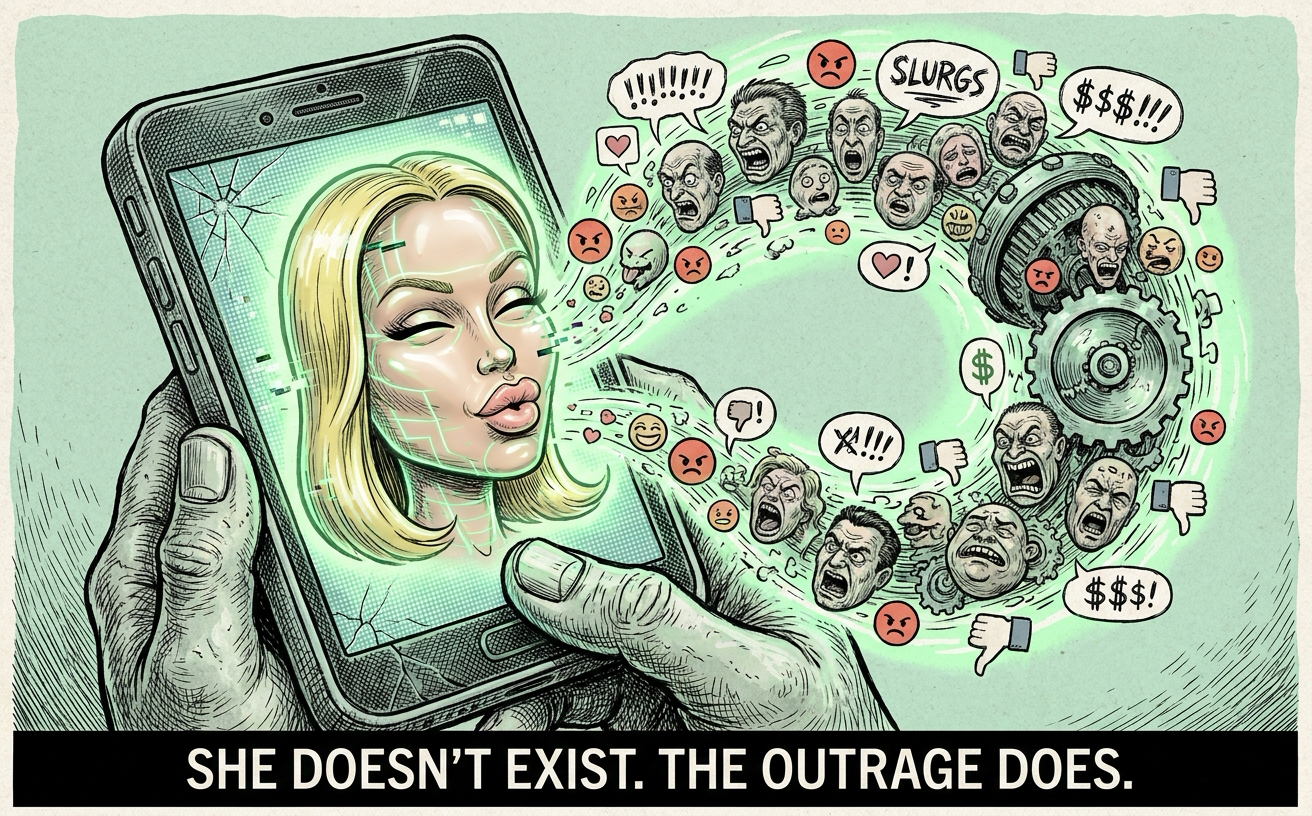
It wasn’t a side-effect. It was the product.
A 2017 study by Brady and colleagues found that adding moral-emotional language to a social-media post about a contentious issue measurably increased how far it spread — each such word bumping diffusion by roughly a fifth. A follow-up tracking millions of tweets showed something worse: platforms actively teach users to express more outrage over time, because outrage is what gets rewarded with reach. And the punchline from the wider literature — outrage drives virality but not effortful action. People share. They don’t sign the petition. The amplification is real; the follow-through is theatre.
The Magda content is engineered to trigger four warring tribes at once, all of whom comment:
- Polish nationalists, furious that a Polish woman is sleeping with foreigners
- Racists from outside Poland, piling on with slurs
- Women, clocking the misogyny and pushing back
- Thirsty men, just engaging with the images
Every flavour of viewer is an asset. The content doesn’t need to be liked — it needs to be responded to. Each enraged reply is a small algorithmic boost. Each pile-on is a viral amplifier. Each furious quote-repost from a Polish-Catholic-nationalist account doubles the reach into precisely the demographic most likely to convert through the funnel. And the operator escalates personally in the replies — vulgar slang, sharp comebacks, performed shamelessness — feeding the loop. She isn’t losing the comment wars. She’s farming them.
The comment section isn't a side-effect of the content. It's the engine of the content. Every flavour of outrage is an asset.
IV. The Wrong Target
So I had the mechanism. The natural next move — the move I caught myself making — was to be furious at the platform.
How is Instagram allowing this? Why hasn’t it been banned? Where is the moderation? When are we going to regulate this?
That instinct is the bit I want to interrogate, because I think it’s the dysfunction the whole thing is really about.
Here’s the maths. By the time you’ve finished this paragraph, the account will have been seen by tens of thousands more people. Even if Instagram bans it tomorrow, the same operator has a new one up by lunchtime. The technical barrier to spinning these up is now hours, not weeks. The economic incentive has multiplied. The supply will scale to meet the demand, indefinitely. Platform-level enforcement is whack-a-mole at infinity.
This is the same shape as climate discourse. Asking Instagram to ban Magda is the equivalent of being furious at one billionaire’s private jet. It feels morally clarifying. It’s specific, named, satisfying to point at. It’s also close to useless — because the actual structure of the problem isn’t a small number of villains making big decisions. It’s a vast number of small decisions making one big effect.
V. Where the Lever Actually Is
The lever is — and I know how this is going to sound — the kitchen table.
What I mean specifically: there’s a tier of social policing that genuinely enforces norms, and it isn’t the platform tier and it isn’t the celebrity-target tier. It’s the small social unit. The group chat. The family dinner. The pub table. The peer-group level.
Here’s the test. When did anyone you know last change their behaviour because Instagram banned an account? Probably never. When did anyone you know last change their behaviour because a friend looked them in the eye and said “that’s actually a bit grim — why are you sharing it?” Plenty of times. That’s where the real norm-enforcement lives.
The Magda content depends on a specific cultural lag to work. AI literacy is meaningfully ahead in UK and US comment culture — every thread for two years has been salted with “AI slop” recognition; every viral clip gets flagged as a deepfake within minutes. The Polish comment section, by contrast, is still largely pre-saturation. Older Slavic Facebook and Instagram demographics are often operating on rough 2015 internet rules: photo means real, video means realer, she said it on camera means settled. Pair that with content built to fire the emotional pathways — rage, lust, nationalism — faster than the analytical ones, and the “wait, is this even real?” question never gets a chance to load.
Where the Policing Happens
Where the outrage goes
Platform bans. Regulator demands. Pile-ons aimed at the named, distant target. Loud, visible, satisfying — and structurally incapable of shifting the behaviour of anyone you'll ever meet.
Where norms actually shift
The group chat. The family dinner. The friend who says "that's AI, and it's racist" instead of laughing along. Quiet, low-status, almost no dopamine — and the only tier that reliably changes what people do.
Filling that gap is not a platform problem. Instagram is not going to teach a 55-year-old uncle in Poland that image-generation exists. The regulator is not going to sit at his kitchen table during Sunday lunch. The thing that would actually move the needle is what I’m going to call umbrella walking: a million tiny, low-stakes acts of clocking-it-out-loud at the small-group level. The reply in the group chat — “btw that’s AI, also it’s racist” — instead of the laughing emoji. The cousin at dinner pointing out that the girl in the photo doesn’t exist. The friend who answers the rage-bait with “this is engineered, look at the captions” instead of taking it.
That tier of correction has atrophied. We’ve outsourced moral commentary to public targets who can’t answer back, because it’s lower-friction and lower-cost than telling someone you actually know, to their face, to knock it off. The performative tier has swollen to fill the space the kitchen-table tier vacated. Both are needed. Only one of them works.
VI. The Externalities
There’s a complication I want to flag, because I caught myself reaching for the easy version of this argument, and the harder version is more honest.
You can construct a Robin Hood reading of the whole thing. The marks at the bottom of the funnel are, disproportionately, the demographic doing the worst of the comment-section abuse: the incels, the racist nationalists, the manosphere accounts. They’re the ones being extracted from. Folk-justice, if you squint.
The Robin Hood frame falls apart on spillage.
The funnel is incel-shaped at the target. The cultural exhaust hits a far wider population:
- Adolescent boys, forming their model of women, sex, Polish women and Black men out of this ambient content whether they pay anyone a złoty or not
- Real Polish women, who absorb the “this is what Polish girls are like now” connotation whether they signed up to it or not
- The empathetic mark — the lonely bloke who thinks he’s supporting a real young feminist, not the racist commenter — who is in a genuinely different moral category from the abusers
- Ambient viewers, the scroll-past-with-a-😂 crowd, who never engage but absorb the trope as wallpaper. Each impression nudges the Overton window microscopically. Multiply by tens of millions and the window slides.
The operator gets paid. The marks get extracted. And the cultural sediment settles on everyone. That’s not Robin Hood. That’s a parasitic loop.
Robin Hood gets to pick his targets. The cultural sediment doesn't get to pick where it settles.
VII. The Umbrella Walkers
There’s a cliché about climate change that gets the shape of the problem nearly right. We blame the billionaire’s jet because he’s named, visible, and satisfying to be furious at. We blame the working-class family on a budget-airline holiday for the inverse reason — they’re a category we can offload guilt onto. Both are the same dysfunction: looking everywhere except the place the actual lever sits, which is in front of us.
The thing that genuinely moves climate is billions of micro-decisions. Walking fifteen minutes to the station in the rain instead of taking the car. A couple of meat-free meals a week. Not heating an empty room. The umbrella-walker tier. It’s unglamorous. It generates no dopamine. There’s no public target to point at. And it’s where the whole problem actually lives.
The Magda funnel is the same shape. The lever is in the group chat. The micro-action is the 😂 you don’t send. The peer-level brake-check used to be a real force in how culture corrected itself, before we collectively decided that all moral commentary should be aimed at distant public figures who can’t answer back.
I’m not saying don’t be angry at Instagram. I’m saying don’t only be angry at Instagram — because that’s the easy version, and the easy version is the one that doesn’t work.
If you’ve read this far and you’re thinking “but I already do all this,” you’re probably already an umbrella walker. The slightly terrifying part is how few people are.
The Bottom Line
There's an AI-generated Polish girl on Instagram running a multi-tier scam funnel that has reached millions of people through algorithmically amplified outrage. She doesn't exist. The outrage does.
The platform isn't going to fix this. The regulator isn't going to fix this.
The next time someone sends you the reel, the lever is in your hands. It's small. It feels like nothing. You say "btw that's AI, also it's racist" instead of laughing along.
That, multiplied by everyone, is the thing that actually moves.
This is the opening piece in The Umbrella Walkers — a series on misdirected moral attention, atrophied small-group accountability, and where culture actually changes. Data referenced: FBI IC3 2024 Internet Crime Report; FTC Consumer Sentinel (romance-scam losses); Chainalysis 2025 Crypto Crime Report (pig-butchering deposits); Ofcom 2024 (deepfake detection); Brady, Wills, Jost, Tucker & Van Bavel (PNAS, 2017); Brady, McLoughlin, Doan & Crockett (Science Advances, 2021); Leach et al. (Social Psychological and Personality Science, 2025) on outrage and petitions; and 2025 reporting on AI-persona fraud. The interpretations — and the rant — are my own.