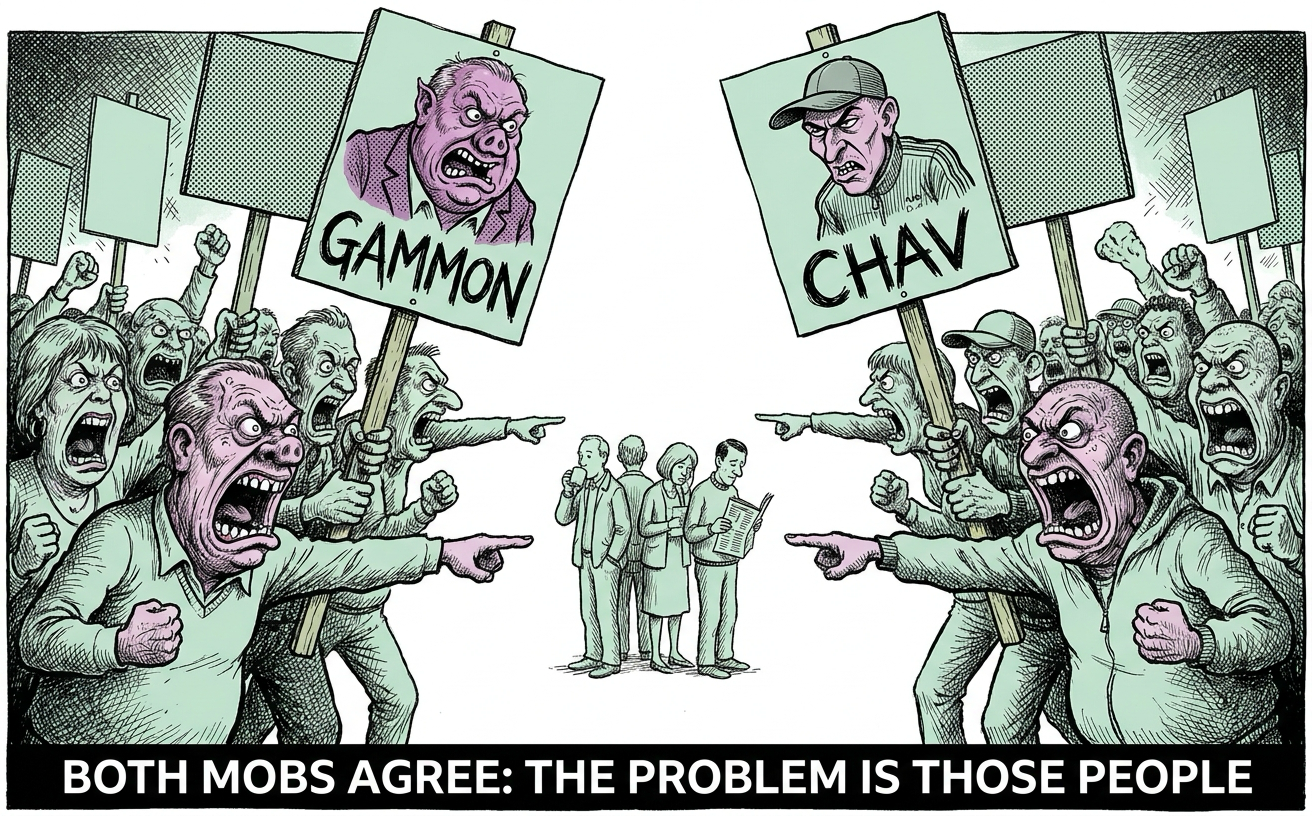
Someone I like sent me a screenshot of a comment section the other week. Under it she’d written one word: gammon. The comment was from a pink, furious, middle-aged man saying something predictably grim about small boats, and the word landed the way it was meant to — I laughed, I felt the little warm click of agreement, I nearly forwarded it on.
Then I did something I don’t usually do, which is nothing, for about a second and a half. And in that second and a half the warm click curdled slightly, because I recognised the shape of the feeling. It was the exact feeling I’d watched my grandfather have, at a different table, forty years and one political direction away, when he said the word “chav” about a family on the news. Same contempt. Same certainty. Same total absence of a specific human being on the other end of it. Different word. Identical machine.
This is the fourth piece in a series about misdirected moral attention. We’ve done the AI influencer, the billionaire’s jet, the flats that never got built. Each time the pattern was the same: outrage aimed at a named, distant, satisfying target, which feels like a moral act and does nothing. This piece is about the most refined version of that dysfunction there is — so refined that the target isn’t even a person any more. It’s a category. And the category is engineered, precisely, so that it can never answer back.
I. The comfortable seat
Here is the inversion, up front. Contempt for a category isn’t a moral position. It’s the most comfortable seat in the house — because the category, unlike a person, can never look back at you and complicate the story.
Think about what a category is doing for you. “Gammon.” “Chav.” “Snowflake.” “Benefits scrounger.” “Gentrifier.” Each one bundles a mass of individual human beings — millions of them, each with a face, a reason, a bad day, a mitigating circumstance — into a single unit with one trait, the trait you’ve chosen to despise. The bundling is not incidental. It is the entire mechanism. You cannot feel clean, uncomplicated contempt for a person, because a person keeps producing inconvenient details: he’s frightened, she’s tired, he was lied to, she’s doing her best. A category produces no details. That’s what it’s for.
The tell is that the category can never rebut you. If you say something cruel about a specific man, the specific man can turn round and be three-dimensional at you, and your cruelty gets harder to hold. Say the same thing about “gammon” and there is nobody home to answer — you’ve picked a target whose defining feature is that it cannot look wounded, cannot say “actually, that’s not why,” cannot be your uncle at Christmas. The impossibility of a reply is not a flaw in category-hatred. It is the reason category-hatred feels so good. You get all of the moral certainty and none of the risk that a human might turn up and spoil it.
A category can't be argued with, can't be persuaded, and can't be hurt. Which is exactly why hating one feels so righteous and does so little.
II. Left and right, same machine
The thing that ought to disturb everyone about this is how perfectly symmetrical it is.
“Chav” is a class slur from above — a comfortable person’s word for the poor, coded as contempt for tracksuits and telly and the wrong trainers, doing the work of “we are not like them” for people who’d never say something so vulgar as “the lower orders.” “Gammon” is a class slur from the other direction — a comfortable person’s word for a different set of the not-comfortable, coded as contempt for a certain age, a certain colour of neck, a certain politics. One is deployed by people who’d be appalled to be called snobs. The other by people who’d be appalled to be called cruel. They are the same word. They point in opposite directions and run on identical hardware.
And almost everyone owns at least one. This is the part that stops it being a piece about other people’s bigotry. The progressive who would rather die than say “chav” says “gammon” without a flicker. The traditionalist who is genuinely, warmly kind to individuals will talk about “snowflakes” as a herd. Each is certain their category is the fair one — mine describes a real problem, theirs is just prejudice. Each is running the machine. The machine does not care about the politics of the person operating it. It only cares that the target can’t answer back, and both targets can’t.
There is a whole field of evidence that we are much worse at this than we think. More in Common, the research outfit that studies political division, gave the effect a name: the perception gap. Ask people to estimate what the other side actually believes and they wildly overshoot the extremity, imagining roughly twice as many of their opponents hold genuinely “extreme” views as really do. The category in your head is not a description of a group of humans. It is a cartoon you’ve been served, that flatters you by being easy to hate. And here is the part that should stop you cold: the more news and social media you consume about how awful they are, the worse your estimate gets. In the same research, the people who followed the news “most of the time” came out nearly three times more distorted in their picture of the other side than those who followed it “only now and then.” The caricature sharpens as the humans blur.
You can see the same distortion wherever we’ve bothered to measure it against a real number. Ask the British public what share of the benefits bill is claimed fraudulently and the average guess comes back at around a quarter of it — 27% in the poll that pinned it down. The government’s own figure at the time was 0.7%. The “scrounger” isn’t a demographic. It’s a feeling with a made-up statistic bolted on afterwards.
III. Why we reach for it
The reason category-contempt is winning is the same reason the jet-rage and the oligarch-blame were winning in the earlier pieces. It pays out instantly and costs nothing.
Naming a real person’s specific bad behaviour is effortful and risky. You have to know the person, or at least the facts. You might be wrong. They might explain themselves. The whole thing might end with you having to revise your view, which is unpleasant, or have an actual conversation, which is worse.
Despising a category is frictionless. There’s no particular person to be wrong about. There’s no risk of a reply. There’s a ready-made crowd who despise the same category and will reward you for the post. And best of all, it feels exactly like justice — like you’ve taken a brave moral stand — when in fact you have taken the safest possible position, which is contempt for people who aren’t in the room and can’t get in.
This isn’t stupidity and it isn’t even, mostly, malice. It’s the path of least resistance dressed as a conscience. And it has a cost that the warm little click of the “gammon” screenshot completely hides.
IV. The counter-argument, which is the strongest in the series
Now the objection, and this one is sharp enough that I want to give it its full weight, because getting it wrong turns this piece into exactly the limp both-sides centrism it deserves to be accused of.
The objection: some categories genuinely do deserve contempt, and refusing to name them is not virtue, it’s cowardice. You cannot fight racism without naming racists. You cannot organise against a harmful movement without a word for the people in it. Every social advance that ever happened required someone willing to say “these people, doing this thing, are wrong” — loudly, as a group, without stopping to humanise each individual member first. Telling people to be gentle and specific while actual bigots operate in the open is not a higher morality. It is disarmament. And “well, both sides caricature each other” is the laziest sentence in the language — a way of flattening a real power difference into a comfortable draw.
That objection is correct, and it draws the exact line this piece needs.
Here is the line. There is a difference between naming a behaviour or a power and hating a category of person as a receptacle. The test is not how angry you are or how justified the anger is. The test is: does your target contain a specific action you actually want to change — or is the target’s non-personhood the entire point? “This man is spreading this lie and it needs countering” is politics. It names a doable thing. “Gammon” names no action, demands no change, and could not be satisfied by any behaviour the despised person could adopt, because the despised person isn’t real enough to adopt anything. The first is a lever. The second is a mood you’re feeding.
The giveaway is whether you would take yes for an answer. If the racist stopped being racist, the person naming the behaviour has won and is delighted. But “gammon” can’t be un-gammoned — there’s no version of that pink furious man that the word would accept, because the word was never about a changeable behaviour. It was about having a face to pour contempt into. A cause wants its enemy to convert. A mood wants its enemy to stay exactly as hateable as it needs them to be.
And this is where category-contempt reveals itself as not just useless but actively counterproductive — the same inert-plus-harmful shape as the jet and the empty flat. Because contempt for the category doesn’t shrink the category. It grows it. The pink furious man, told he is “gammon,” does not reconsider; he hardens, he finds the others who’ve been called it too, and the caricature you had of him becomes, by your own hand, a little more true. The perception gap isn’t just a measurement error. It’s a machine for manufacturing the enemy it claims to describe.
V. The umbrella walk, at your own table
So what is the lever, given that the category is a decoy and the contempt is a mood that feeds the thing it hates?
It is the same tier it has been every time in this series. Small, close, unglamorous, socially costly. And in this case it has a face.
The lever is the one actual member of the hated category you already know — treated as a person who can answer back. Not the abstract mass; the specific human. The uncle who’s “gammon.” The cousin on benefits. The nephew you’d have called a “chav” if he weren’t yours. The one flesh-and-blood member of the category you’re allowed to despise in the abstract, sitting at your own table, about whom you cannot maintain the cartoon because he keeps being a person at you.
Everything that has ever moved anyone’s actual views moved at this tier. Nobody was ever argued out of a prejudice by a post about the category. People change their minds about “those people” precisely when one of “those people” turns out to be someone they love, or work beside, or owe something to — when the category cracks open and a human climbs out. This has a name and seventy years of evidence behind it: Gordon Allport called it the contact hypothesis in 1954, and a 2006 meta-analysis by Pettigrew and Tropp ran the numbers across 515 studies and found the same thing almost everywhere they looked — more genuine contact with a group reliably predicts less prejudice about it. The single most reliable predictor of somebody softening on a despised group is knowing one of them well. The umbrella walk here is refusing the word about the group and doing the harder thing with the individual: staying at the table with the uncle instead of screenshotting a stranger.
And the small, low-status, no-applause version of it — the bit that costs something — is declining to deploy the category word in your own circle, where it would earn you the warm click and the easy agreement. Not sending the “gammon” screenshot on. Being, mildly and unrewardingly, the person in the group chat who says “he’s a scared idiot, but he’s a person” and gets no likes for it. That is the whole move. It feels like nothing. It feels, honestly, a bit wet — like you’ve failed to land the joke everyone wanted. That feeling is the social cost, and the social cost is why almost nobody pays it, and the fact that almost nobody pays it is why the machine runs unopposed.
Where the contempt goes vs. where minds actually move
The category
"Gammon." "Chav." "Scrounger." "Snowflake." A face-shaped hole you pour contempt into. Can't answer, can't convert, can't be your uncle. Feels like justice, hardens the enemy, changes no one.
The person at your table
The one real member of the group you actually know. Keeps being three-dimensional at you. The only tier at which anyone has ever changed their mind about anything — and the one that costs you the warm click of agreement to stay at.
None of this means going soft on the powerful, or pretending real bigotry is a misunderstanding. Name the behaviour. Fight the power. Take yes for an answer when it comes. But notice the difference between that and the screenshot — between wanting your enemy to change and wanting him to stay hateable so you can keep enjoying the feeling.
VI. Back to the screenshot
I didn’t forward it. Small thing. Nobody clapped, because nobody knew — the entire content of the act was an absence, a share that didn’t happen. My friend is still lovely and still says “gammon,” and I have said nothing to her about it, because that would be the next umbrella walk and I have not yet been brave enough to take it. This series keeps ending with me at the foot of a hill I haven’t climbed. I’d rather tell you that than pretend.
But I keep thinking about my grandfather and the word “chav,” and how completely certain he was, and how he’d have been baffled and hurt to be told he was doing anything other than describing the obvious truth about a type of person. That’s the thing about the comfortable seat. From inside it, it doesn’t feel like contempt. It feels like clarity.
The Bottom Line
"Gammon," "chav," "scrounger," "snowflake" — the category is the purest hit of moral outrage there is, because you've picked a target that can never turn round and become a person.
That's not a stand. It's the safest seat in the room, and it grows the very thing it claims to fight.
The uncle you'd write off as a category is sitting at your table, being a person, right now. That's the only place anyone's mind has ever changed.
Name the behaviour if you must. But the moment your enemy stops being able to answer back, you've stopped doing politics and started feeding a mood.
This is the fourth piece in The Umbrella Walkers — a series on misdirected moral attention and where minds actually change. It follows the AI influencer who doesn’t exist. Data referenced: More in Common’s research on the “perception gap” (Yudkin, Hawkins & Dixon, 2019), on how far we overestimate the other side’s extremity and how media consumption widens the gap; TUC/YouGov polling on public perceptions of benefit fraud (27% guessed) against the government’s own 0.7% fraud figure; and the intergroup-contact literature — Gordon Allport’s contact hypothesis (1954) and the Pettigrew & Tropp meta-analysis of 515 studies (2006). The interpretations — and the screenshot I didn’t forward — are my own.