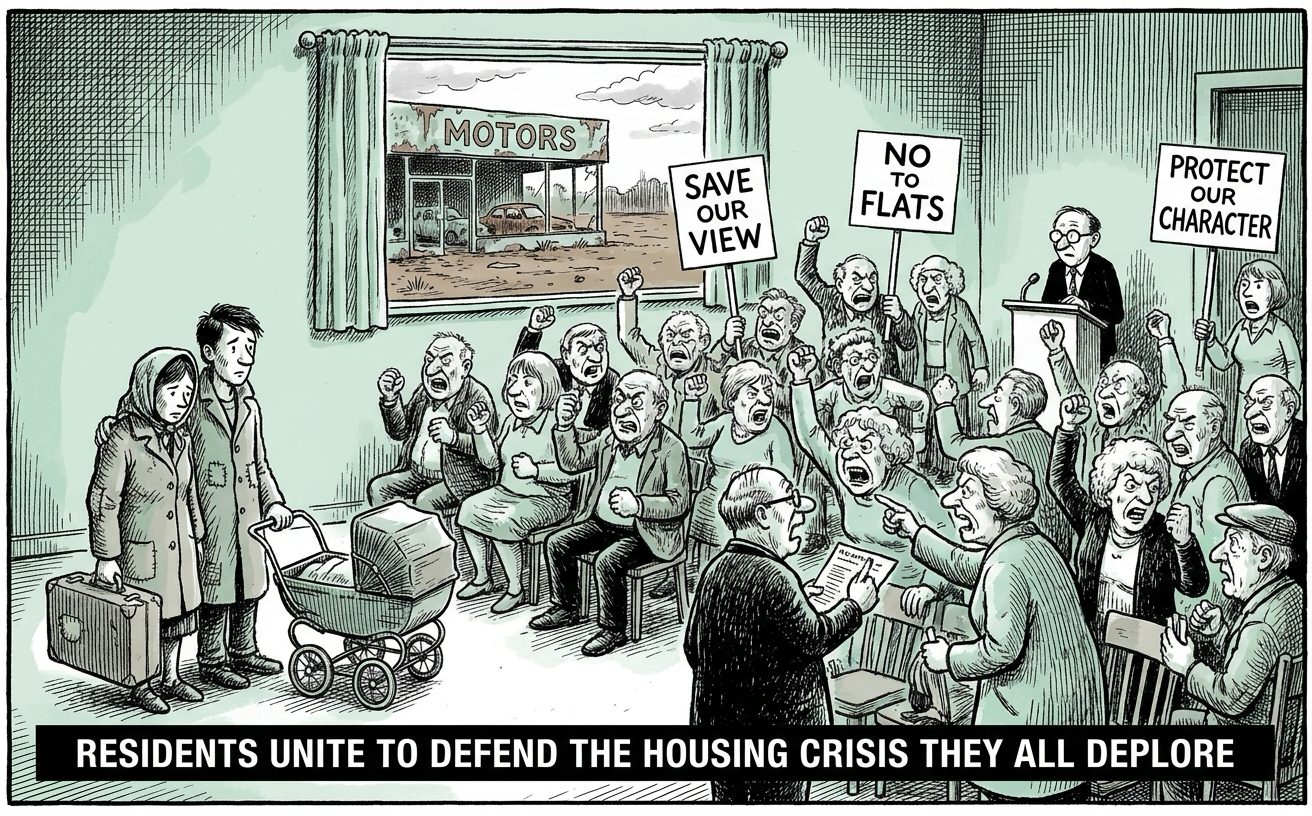
There is a Facebook group for the bit of town I live in. Bins, lost cats, a running feud about a hedge. Useful, mostly. Last month a planning notice went up: a developer wanted to put thirty-four flats on the site of a knackered old car showroom near the station. Brownfield, walkable, exactly the sort of thing everyone claims we need more of.
The group went off like a bonfire. Not for the flats — against them. Traffic. Parking. “Character.” One woman wrote, without apparent irony, that we should be building homes for young families instead — on a two-bed flat development, five minutes from a train line, which is close to the platonic ideal of a home for a young family. Eighty-odd comments. Objections drafted. A little committee formed.
And every single person in that thread, if you’d asked them over a cup of tea, would have told you — sincerely, with feeling — that the housing crisis is a scandal, that it’s ruining a generation, and that Something Must Be Done. They meant it. They also killed thirty-four flats before lunch.
This is the third piece in a series about misdirected moral attention. The first was an AI influencer who doesn’t exist; the second was the billionaire’s jet. This one is the crisis where the gap between the villain we name and the lever we hold is at its widest and its most uncomfortable — because in this one, the lever isn’t the billionaire. It’s the neighbour. And, if we’re honest, it’s sometimes us. Stay with me.
I. The line-up
Ask anyone whose fault the housing crisis is and you will get a name. You will get several. The list is long, well-rehearsed, and available in a flavour to suit every politics.
If you lean one way: foreign investors, buying up London as a safety-deposit box with windows. Landlords, hoovering up the stock and renting it back at ransom. Developers, land-banking permissions to keep supply tight and prices high.
If you lean the other: immigration, raw demand outrunning the houses. The planning system, strangled by red tape. Boomers, sitting on four-bedroom houses and the ladders they pulled up behind them.
Every one of these is a named, distant, satisfying target. Every one of them is, at most, a minor character. And the reason we keep the whole line-up on rotation is that as long as the criminal is always someone else — someone rich, someone old, someone foreign, someone elsewhere — we never have to look at the person filing the objection to the flats at the end of the road.
Here is the inversion, and it is not a comfortable one. The housing crisis doesn’t really have villains. It has beneficiaries — and most of them are ordinary, sympathetic, entirely reasonable people, possibly including you.
II. The cold hard data
Take the villains one at a time, because the numbers deflate them one at a time.
Foreign investors. The empty-Knightsbridge-flat image is vivid and real. It is also tiny. Individuals with an overseas correspondence address hold about 0.7% of all registered property titles in England and Wales — roughly 182,000 of them — and the money clusters in a handful of prime central London postcodes, with Westminster and Kensington and Chelsea alone accounting for the bulk, postcodes that were never going to house a nurse in Leeds anyway. Empty homes tell a similarly thin story: around 265,000 dwellings sat long-term vacant across England in 2024, about 1% of the stock, and filling every one of them tomorrow would not touch a shortfall counted in millions.
Landlords and developers. Land-banking is the favourite. But when Sir Oliver Letwin was sent to find the cartel in 2018, he came back with something duller. The brake on how fast homes get built once permission is granted isn’t developers hoarding land — it’s the “absorption rate,” the pace at which a site’s homes can be sold without the builder undercutting their own prices. On the largest sites the median build-out period runs to 15.5 years. Permissions routinely outrun completions, which points less at a conspiracy to keep land idle and more at a system where building the thing, and selling it slowly enough not to crash the local market, is the hard part.
Now the number that actually matters.
In 1997 a typical English home cost about three and a half times a typical full-time salary. By 2024 it cost 7.7 times — a £290,000 house against £37,600 of median earnings — and that was an improvement on the 8.4 of the year before. The blunter version: in 1997, 88% of local authorities had homes selling for under five times local earnings. By 2024, 9% did. That is not a story a hundred oligarchs can carry. That is a structural shortfall, compounding for decades.
And the shortfall has a boring, undramatic cause: for forty years we have built far fewer homes than we form households.
England has a working target of roughly 300,000 net new homes a year. In the modern era it has hit that number exactly never — 221,000 in 2023-24, 209,000 in 2024-25, and pointing down. The persistent gap between that green line and the bars is the mechanism. Everything else is set dressing.
The generational cut is the part that turns numbers into grief. Among people born in 1961-65, 47% owned their home by the age of 28. Thirty years later, that had fallen to 27% — households headed by thirty-year-olds are now about half as likely to own as the boomer generation was at the same age. Four in ten of today’s thirtysomethings rent privately; fifty years ago it was one in ten. The boomer didn’t steal the house. The house simply stopped being reachable, and the person who already owns one has no structural reason to want that to change.
III. The mechanism nobody wants to be
Here is why the flats died, and why they keep dying.
Roughly two-thirds of English households — 65% — own their home. For that majority, the house is not shelter. It is the single largest asset they will ever hold, and often the entire retirement plan. Its value depends on one thing above all others: scarcity. More homes near yours, cheaper yours becomes. This is not greed. It is not even conscious. It is a structural interest, sitting quietly under the floorboards of every “objection on the grounds of character” ever filed.
So the machine works like this. The national interest — more homes, cheaper homes, a reachable ladder — is diffuse, spread across millions of people, many of whom don’t live here yet because they can’t afford to. The local interest — no change, no traffic, no “overlooking,” asset value protected — is concentrated, organised, and armed with a planning system that lets any determined minority object.
The diffuse majority never shows up, because you cannot show up to a parish planning meeting on behalf of the family who would move into a flat that doesn’t exist. The concentrated minority always shows up, because they can see the car showroom from their window.
This isn’t a conspiracy. It is a thousand entirely reasonable people, each defending their own street, their own view, their own pension, in a system that adds every one of those reasonable local vetoes into a national catastrophe. The oligarch is a story we tell to avoid noticing that the murder weapon is a stack of politely worded objection letters, and our fingerprints are on some of them.
The empty oligarch flat is the villain we can afford to hate. The flats that never got built at the end of your road are the ones that actually mattered.
IV. The counter-argument, which has a point
Now the objection, and it deserves a fair hearing, because “just blame the NIMBYs” can slide into victim-blaming faster than it looks.
The objection: this is structural, and pinning it on ordinary homeowners is a distraction from the real machinery. Right to Buy sold off the social housing stock and never replaced it. The financialisation of property turned homes into an asset class the whole banking system now depends on staying expensive. Interest rates and mortgage availability, set nationally, drove the boom far more than any local objection. The system rewards the objection — of course people defend their asset; you built them a world where the house is the pension. And foreign capital genuinely did distort prime London, and developers genuinely do optimise their build-out for price. Blaming the woman in the Facebook group is letting the architecture off the hook.
Most of that is true. And here is where it still doesn’t get us off the hook.
Every structural fix on that list — build more social housing, reform the tax treatment of property, liberalise planning so the homes actually get built — runs through the identical bottleneck. It dies at the local tier. Planning reform is national policy that is executed one site at a time, and every site has a Facebook group. Governments of both parties have announced housing targets for decades and been beaten, every time, not by oligarchs but by the aggregate of local objection — the “concreting over the countryside” panic, the safe-seat rebellion, the councillor who reads the room and refuses the application.
The structural change and the neighbour are not two separate problems. The neighbour is where the structural change goes to die. You cannot reform your way past ten thousand local vetoes without addressing the thing that makes people cast them — which lives, once again, at the small-group tier. The kitchen table. The Facebook group. The parish meeting where six people decide the shape of a generation’s housing.
V. The umbrella walk, in a hard hat
So where is the lever — the unglamorous, low-status, in-the-room thing, given that the villains are a decoy and the mechanism is us?
It is the housing version of walking to the station in the rain. It saves nothing on its own. It is socially expensive. And it is the only tier where the crisis is actually decided.
The lever is being the voice that backs the development near you — out loud, to the people who will object to it. Turning up to the meeting the objectors turn up to, and being the yes. Writing the boring letter of support for the thirty-four flats, because the planning system counts letters and almost nobody ever writes one in favour. Saying, in your own Facebook group, in front of your own neighbours, “actually, we should build these” — and taking the frost that comes back.
This is genuinely harder than raging at foreign investors, and the difficulty is the whole point. Hating the oligarch costs nothing; you will never meet him. Backing the flats costs something real: the neighbour cools on you, the WhatsApp group goes quiet when you post, you become, faintly, the person who “wants to ruin the area.” That social cost is exactly why the pro-housing majority stays silent and the anti-housing minority wins by default. The objectors are loud because objecting is safe among objectors. Support is silent because support is awkward.
There is a name for the missing voter here: the family who would live in the flats, who cannot attend the meeting because the flats don’t exist yet and neither, in this town, do they. Somebody has to be their proxy. In every planning fight in the country, the future resident has no vote and no seat. The only person who can hold that seat is a current resident willing to spend a little standing on someone who isn’t in the room.
Where the housing anger goes vs. where it works
The satisfying target
Oligarchs, boomers, landlords, immigrants, developers. Distant, nameable, blameless of the specific flats that just died. Generates a strong feeling and zero homes.
The umbrella-walker tier
The letter of support nobody writes. The "yes, build it" you say to your own neighbours' faces. Costs you social capital, wins you no applause — and is the exact tier where every home is granted or refused.
To be clear, this is not instead of politics. It is the ground politics stands on. A government can only liberalise planning as far as the local temperature allows. Change the temperature in your own small group — make “we should build here” a normal thing a reasonable person says at a normal meeting — and you have done more for the national policy than any amount of fury at a man in Dubai.
VI. Back to the group
The flats near me were refused. The car showroom is still there, rusting, housing no one, protecting the view and the asset values of the people who objected. Everyone in that Facebook group still believes the housing crisis is a scandal. They are right. They also, collectively, are it.
I didn’t write a letter of support either. That is the honest ending. I read the thread, I felt the familiar thing — this is mad, these are exactly the homes we need — and I closed the app and did nothing, because posting “actually I think we should build these” into eighty angry neighbours is precisely the small, damp, unrewarded act this whole series is about, and I flinched from it same as anyone.
There is another site going through consultation now. Same station, different corner. I know where the meeting is.
The Bottom Line
The housing crisis has a full cast of villains — foreign money, boomers, landlords, developers — and hating any of them is free, satisfying, and completely inert.
The homes are not lost in Dubai or Westminster. They are lost one planning meeting at a time, killed by reasonable neighbours defending a view and a pension, into a silence where nobody spoke for the family who'd have moved in.
The lever isn't a villain to blame. It's a letter of support to write, with your own name on it, in front of people who'll be annoyed you did.
This is the third piece in The Umbrella Walkers — a series on misdirected moral attention and where change actually happens. Data referenced: ONS, Housing affordability in England and Wales (2024 and 2025) for the price-to-earnings ratio; MHCLG dwelling-stock and long-term-vacancy tables; HM Land Registry / Centre for Public Data on overseas ownership; the Independent Review of Build Out Rates (Letwin, 2018); MHCLG net-additional-dwellings statistics; the English Housing Survey 2023-24 for owner-occupation; and the Resolution Foundation and IFS on home ownership by birth cohort. The interpretations — and the letter I didn’t write — are my own.