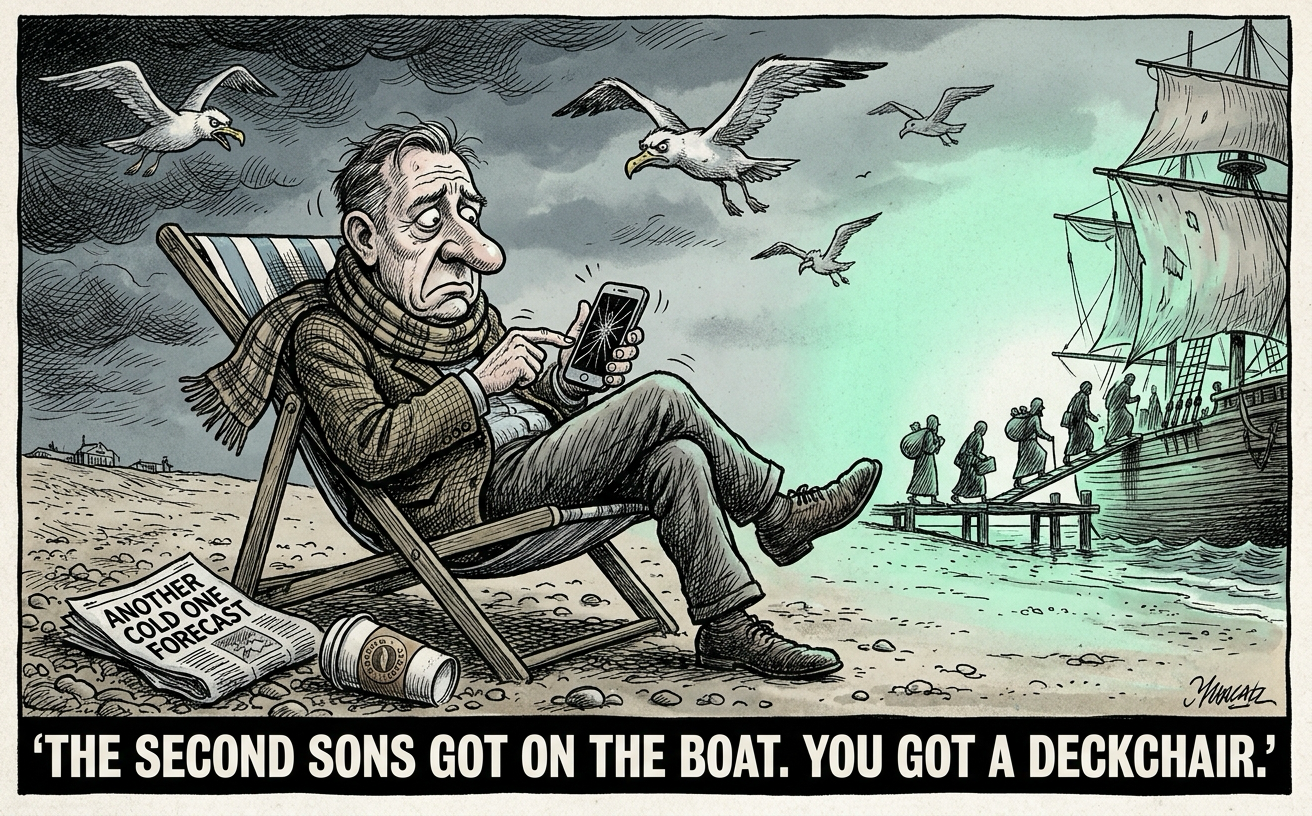
This is the companion to The Manor Never Closed. That piece argued the British social system is working exactly as designed: a 1912 ownership structure with a 1948 floor and a 2026 PR strategy, held stable by atomisation, identity substitution, and the genuine material comforts of life inside a wealthy, declining empire.
This one is about what to do about that.
It is not “vote harder.”
A Story About Tax Policy
Before I tell you what to do, I need to tell you about the East India Company.
Not to celebrate it. By any honest accounting it was one of the most destructive corporate entities in human history — famines, wars, extraction at industrial scale, the deliberate dismantling of the Indian textile industry to make a captive market for Lancashire mills. Nothing about it deserves rehabilitation.
But one element of its founding context is worth understanding, because we no longer have its equivalent, and that absence explains more than people think.
The element is primogeniture.
Primogeniture was the rule that the first-born son inherited everything. Land, title, estate, income, seat in the Lords, the lot. Effective inheritance for the first son: total. Effective inheritance for the second son, the third, the fourth: nothing.
These men still had everything they needed in the immediate sense. White glove, silver plate, no work requirement, no debt spiral. Fed, housed and educated to a standard the rest of the country couldn’t dream of. What they didn’t have was a future inside the manor. Marriage prospects without an estate: nil. Professional prospects inside the family system: closed. They were structurally surplus.
What they did have, in enormous quantities: time, because there was no job to go to. A little capital — an allowance, sometimes a one-off setup sum. An education at Eton and Oxford. A social network that opened every door in London. A brother in the magistracy and an uncle in cabinet. And no moral framework worth the name.
So they didn’t stand on the beaches of Margate. They didn’t riot on the white cliffs of Dover. They didn’t sit in country pubs grumbling that the system had let them down.
They got on the boat.
Raised capital. Called in favours. Drew up plans — they called them charters. Sailed off to extract value from places that had not, until recently, been on the receiving end of British attention. Many died of malaria. Many did monstrous things. Some became fabulously rich.
And — this is the awkward bit — by any technically accurate definition, they were founders. They scoped markets, raised capital, and built logistics networks across oceans at a time when logistics meant six-month voyages and a crew mortality rate you would now call a catastrophe. They negotiated with local power structures, usually at gunpoint. Innovators, entrepreneurs, builders — doing pernicious, immoral, exploitative things, but with an entrepreneurial energy nobody in Britain has matched since.
The pressure came from the inheritance system. Not from a government policy. From a social contract about who got the manor.
Take that pressure away and they don't go anywhere. They sit in Hampshire shooting pheasants. The empire doesn't happen. The horrors don't happen.
But the energy doesn’t get redirected either. It just dissipates.
You Have More Than They Did
Here is what should keep you up at night.
The British professional class in 2026 has every one of those advantages, plus one they didn’t have.
Same Hand, Better Cards
The second sons (c. 1820)
Time, because there was no job. A modest allowance. An Eton-and-Oxford education. Every door in London. A brother in the magistracy. Six-month voyages on ships where roughly a third of the crew died en route. And no conscience to slow any of it down.
You (2026)
Time — remote work, freelance, a sabbatical, a redundancy cheque. Capital — savings, home equity, the same redundancy cheque. One of the best university systems on earth. A global network your phone carries for you. English, the operating system of world commerce. Flights at £200 return and near-zero mortality. And the one thing they never had: a functioning moral compass.
The last line is the difference. The second sons had every advantage except the one that would have stopped them doing harm. You have every advantage including the one that prevents it.
So what are we doing with it?
We buy second homes in Cornwall we visit four weeks a year. We argue with strangers online about the culture war. We optimise our pensions and watch property programmes. We pay £500 a month to rent a wardrobe in Hackney. We get on the housing ladder two rungs from the bottom and call it aspiration. We fly to Bali to shoot drone footage of ourselves typing on a beach, hashtag passive income. We buy rental flats in Lisbon and Athens and price out the locals — colonialism with extra steps and a content strategy.
We are not, on the whole, using it to build anything, anywhere, that matters.
What This Is Not
Let me cut off the obvious responses before they form.
This is not digital nomadism. Posing on a beach in Canggu with a MacBook while running a dropshipping store that sells things made by underpaid workers in Guangdong to underpaid workers in Ohio is not the thing. That’s remote work with a tan, and a faintly extractive one.
This is not Airbnb landlording in cheap markets. Buying up flats in Tbilisi or Mexico City to rent to other westerners is colonialism by app. The effect on local housing is exactly what it looks like.
This is not a gap year with a saviour complex. Building part of a cinder-block house in Bolivia to put on a university application is not the assignment. Your mission is not to preach, price out, or pity. The state of Britain in 2026 gives you no right to claim the gospel.
This is not the performative version. Not the “boycott the whole rotten system — one second, let me just top up the oat-milk flat white — hashtag solidarity” version. Not the kind that comes with merch, an Instagram presence, and a podcast about decolonising mindfulness.
This is not charity. Charity is what fills the gap when the system fails. You are not the gap-filler. The gap-filler is a feature of the system you are meant to be withdrawing from.
What This Actually Is
It is rebellion against a system so entrenched you cannot fight it from within. Only by leaving.
Read that again. It is the whole thing.
You cannot fix this country from inside this country. The structure has been engineered, over a century, to absorb and neutralise every form of internal opposition. Vote, march, write, sign, organise, donate, occupy — all of it has been priced in. The system will let you do any of it, because the system already knows none of it threatens the underlying arrangement.
What the system has not priced in is withdrawal.
Withdrawal of your spending. Of your tax base. Of your demand for a £500-a-month wardrobe in Hackney. Of your time, your skills, your CV, your network, your savings. In aggregate, you are the system. It runs on you.
This isn’t about you single-handedly bringing down the British state. It’s about you no longer being the asset that maintains it.
The Practical Bit
What you actually do is this.
Take your capital. A few thousand pounds will do. This isn’t a private-equity move. You don’t need a war chest, you need a runway.
Go somewhere with a market. A market, a workforce, and an institutional ceiling on what locals can build that sits lower than it should. Most of the world qualifies. The barrier is not finding the place. The barrier is being honest with yourself about why you’ve ruled it out.
Build a real business. Not an Airbnb. Not a content brand. A thing that does something — service, product, consultancy, marketplace, education, software, agency, whatever your skills support.
Hire people locally. Pay them well by local standards, which will still be lower than UK standards, which means the unit economics work for you and for them at the same time. Anyone who calls that exploitation hasn’t run the numbers.
Train them. Give them access to the markets, capital, networks, and tools that have been systematically withheld from them by the global financial architecture you’ve spent your whole life inside. You speak the languages of those gatekeeping systems. You know what they want to see. You can build the bridge.
Use the infrastructure that already exists. None of it needs a visa programme or a government scheme. It was built by other people for other reasons and is sitting there, available to anyone with the wit to use it.
| What you need | Where it already is |
|---|---|
| Payments | Stripe, Wise, Revolut Business |
| Distribution | eBay, Amazon, App Store, Google Play |
| Compute | AWS, Cloudflare, Vercel |
| Sales | LinkedIn, your existing network, cold email |
| Legal identity | UK passport, credit card, business bank account |
| Knowledge | Claude, ChatGPT, YouTube, the entire indexed internet |
| Talent | Locally — often better and hungrier than at home |
Do it better than the second sons did. They had no moral framework; you do. They had no examples of what not to do; you have two centuries of them. They built extractive companies because they didn’t know any other kind. You know exactly what an extractive company looks like, and you have the option not to build one. Use it.
Get Rich By Doing Good
Here is the part nobody says out loud, because it sounds suspect.
You will make more money this way than you will at home.
Two Ladders
The ladder at home
The bottom rung is at head height and the rungs above it are made of inherited wealth. Grind your way up two or three through your forties, sacrifice everything else, and end up owning a house in a worse area than your parents' and a pension that won't see you through retirement.
The ladder abroad
Charge in hard currency for what you do. Operating costs a fraction of home. A team paid well by local standards. Institutional barriers low, because nobody else can navigate the international payment rails. Your accent on a sales call closes deals on its own. The maths runs the other way.
Get rich by doing good is a good pitch. It also happens to be true.
And here is the bit that should make you smile: in aggregate, this is the thing that finally changes the manor. Not because you become a political movement. Not because you organise. Not because anyone in Westminster notices. Because the manor only stands if the servants keep showing up. Pull enough of us off the staffing rota and the structure has to change. It cannot afford not to.
The Uno Reverse Card
Here is the kicker — the bit I want carved on the headstone of the British property market.
Once your business has grown. Once you have the capital. Once the ladder at home has finally fallen over because nobody was left holding it upright —
You come back and buy up property to rent to the lords and ladies you left behind.
Not as revenge. Just as good business. The flow of capital reversed. The terms of the arrangement renegotiated. The ownership question, for the first time in a century, re-opened.
This is one generation’s work. Maybe two. It is the most plausible mechanism I can construct by which the structural inequality of British life is actually altered, rather than merely complained about.
The Closer
The second sons of 1820 didn’t sit around waiting for primogeniture to be repealed. They got on the boat.
The second sons and daughters and everyone else of 2026 are sitting around waiting for the system to start valuing them. It will not. The system is fully occupied servicing its asset base and sliding off its demographic cliff. You are not in the budget.
You have more capital than they had. More skills. More ethics. More information. Cheaper flights. Better technology. A functioning moral compass and a century of cautionary tales. You have, in the most literal sense, no excuse.
Lagos is warmer than Margate.
So is Bangalore. So is Mexico City. So is Lisbon. So is essentially everywhere a long-haul flight will take you. The food is better. The people are friendlier. The pace of life is one you’d recognise as more honest. And the ceiling on what you can build is much lower, because nobody’s already built it.
You can keep paying £500 a month for the wardrobe in Hackney. You can keep arguing about asylum seekers on Facebook. You can keep waiting for the council to mend the pothole.
The Bottom Line
You are holding the same hand the men who built the empire held — the time, the capital, the education, the network — with better cards in it and a conscience they never had.
They didn't wait for the rules to change. They left, and the rules changed anyway.
Or you can get on the boat.
This is the companion to The Manor Never Closed. The history is drawn from Royal Museums Greenwich on the hazards of East India Company service, the recorded mortality of the East Indiamen (Dutch East India Company voyages averaged roughly 23% deaths between 1710 and 1775, with the worst voyages far higher), and the economic-history literature on primogeniture, entail, and the flow of the gentry’s younger sons into the military, the merchant trade, and the colonies. The opinions — and the boat — are my own.