I spent years working on Universal Credit from the inside.
Not making the policy — I’m not that senior, and the people who make the policy don’t have the look of people who’ve been on the receiving end of it. I worked the layer underneath: the bit where someone has decided a number and someone else has to translate that number into a flowchart, a journal entry, a Gateway interview, a sanctions schedule. The bit where the abstract becomes the actual.
I left a while ago. And in the last few months I’ve been having the conversation I should have been having for the entire decade I was in the room. It goes something like this: None of this is broken. All of this is working exactly as designed. The design is the problem. The more I have it, the more I realise we are not, as a country, allowed to say it out loud — because if we did, the next question would be who designed it?, and the answer to that is the bit nobody is supposed to know.
I’m aware this is going to sound like a rant. Stay with me. Let me show my working.
I. The Cold Hard Data
Let me start with the version of the system that actually exists, not the one in the ministerial briefings. The whole apparatus costs the state around £83 billion a year, so this is not a rounding error we’re being careless with.
Take Sarah. Thirty-four. Her employment contract just ended. She lives in a flat in Bromley where the rent is £1,400 a month and which she can no longer afford. Her parents won’t take her back. She has no savings. She has a brain, a CV, and an idea for a social media consultancy. She walks into the British welfare system expecting it to be — at minimum — a system. Designed by people. Internally consistent. Calibrated to some recognisable conception of what a human being in 2026 needs to survive.
Here’s what she finds.
Now wait one year. Sarah turns 35.
Nothing about her circumstances has changed. Same flat. Same body. Same job hunt. Same need for a roof. Same Sarah.
Her housing element jumps to roughly £1,280 a month.
That is not a flaw in the system. That is the system. There is a number, set by a politician at some point in the last decade, that says a 34-year-old can survive in a wardrobe-sized room with a shared kitchen but a 35-year-old deserves a front door. There is no underlying calculation. There is no cost-of-living anchor. There is no human reasoning. There is just the number, and the number is what it is because of a bargaining process between Treasury and DWP that none of us were in the room for.
I sat near that room. I have heard, in the corridor outside it, the precise tone of voice in which a senior official explains why the Local Housing Allowance has been frozen for another year. It is the same tone in which you would discuss the float-valve setting on a boiler.
The Minimum Income Floor
Sarah tells UC she’s going self-employed. Here is what happens to her the day her start-up period ends, twelve months in.
DWP starts treating her as if she earns a full-time minimum wage — around £1,850 a month gross — whether or not she does. If she earns less, and she will, because she’s building a consultancy and the second-year pipeline is famously the hardest, UC is calculated as if she made the floor anyway. Quiet month, zero UC. The Minimum Income Floor doesn’t care whether your business is real. It was designed to deter people from declaring fake self-employment to dodge the work-search rules. It catches every actual founder in the country in the same net.
The Capital Trap
She incorporates. She wants to be a proper grown-up business. She wants to retain a few months’ operating expenses inside the company so she can survive a slow quarter.
She can’t.
The “look-through” rule in the Universal Credit self-employment regulations treats a sole-director limited company as her personal capital. Anything above £16,000 in the company bank account, and her UC stops entirely. She is permitted to be a business but not permitted to be a business with a buffer.
You read those numbers and you assume someone, somewhere, has done the maths. They haven’t. They are the residue of fifteen different political compromises stacked on top of each other, each one solving a different fictional villain — the welfare scammer, the holiday-fraud claimant, the dividend-shielding director — and producing as a side effect this baroque, hostile, internally inconsistent rulebook that the average claimant has approximately zero chance of navigating without making a clerical error that becomes a fraud investigation.
This is the version of the welfare state I spent a decade implementing. I’m not pretending I helped fix it. I’m telling you what I saw.
II. The Six Concurrent Traditions
Here’s the thing nobody in the building will say out loud, because the building can’t function if it admits this.
The British welfare state isn’t one welfare state. It’s six, running concurrently, in the same system, with no reconciliation mechanism. Each was the answer to a different question asked by a different decade. None of them have been turned off. They are stacked, in the same rulebook, contradicting each other on every page.
Six Welfare States in One
Poor Law (Victorian)
Relief is moralised, conditional, and deliberately slightly worse than the worst job available. The sanctions regime. The fraud-fear framing. "Skivers vs strivers."
Beveridge (1942)
Universal social insurance. Contributory. Dignity-based. The NHS. New Style JSA. The state pension's framing as "you paid in."
Thatcher (1980s)
Markets default. State residual. "Stand on your own feet." Right to Buy. The housing market as the engine of middle-class wealth.
New Labour (1990s)
Tax credits. Targeted support. Means-testing as compassion. "Rights and responsibilities." The childcare element. The disability element.
Austerity (post-2010)
Means-testing as fiscal discipline. Frozen thresholds as stealth cuts. The LHA freeze. The two-child limit (until 2025). The benefit cap.
Post-Brexit (post-2016)
Sovereignty as vibe. Control without framework. The Hostile Environment. No actual settlement on what we owe each other.
These are six different answers to the question “what should Sarah have?” They run concurrently in the same system. Nothing reconciles them.
UC’s conditionality is Poor-Law-coded. The NHS is Beveridge-coded. Housing is Thatcher-coded. Childcare is New-Labour-coded. The actual numbers are austerity-coded. The rhetoric is post-Brexit-coded. So you get a country where a four-year-old with a heart defect gets world-class NHS care for free, while her mother loses the flat because the LHA freeze didn’t keep up with rents. Both true. Same week. Same family. Civil servants, when this happens, do not bat an eyelid — they have been trained not to see the contradiction. The contradiction is the system.
We are running a 1948 operating system on 2026 hardware, and every patch makes it weirder. UC is the patch on a patch on a patch.
III. The Welfare Equation Nobody Will Write Down
Strip out the politics for a second and the maths is brutally simple.
(number of dependants × cost of living) = (number of contributors × contribution)That’s the entire welfare state, in one line. You can shuffle the inputs. You cannot escape the identity.
The UK has been pretending we can escape it for about thirty years, by doing five things in sequence.
Pretending pensioners aren’t dependants. “They paid in” — true, but they paid in to fund the previous generation’s pensions, not their own. The state pension is a transfer, not a savings account. Demographically, an inverted pyramid. We have not been honest with anyone about this since roughly 1993.
Pretending the working-age sick aren’t dependants. PIP, LCWRA — same equation, different line. The 2025 reforms started to acknowledge it. The 2025 reforms were politically catastrophic. Take from that what you will.
Pretending children are cheap. They are, until you cost in education, healthcare, social services, and the four-bedroom house their parents bought on borrowed money so they wouldn’t have to share. Then they aren’t.
Pretending tax rises are politically possible. They aren’t, beyond the margins. The 45% additional-rate threshold doesn’t fund anything material. The real money is in widening the basic-rate base or putting VAT on more things, and neither survives contact with a focus group.
Pretending growth will solve it. Growth would solve it. We have not had compound growth above 2.5% since 2007. The OBR forecasts beyond 2030 quietly assume we will, because the alternative forecast is too uncomfortable to publish.
And the gap between what the equation requires and what we collect gets papered over with borrowing.
Borrowing is just deferred tax. Future workers will collect it. We are, with perfect equanimity, stealing from a generation that has not yet been born, to avoid having a conversation now that would end careers.
IV. The Honest Choice We Refuse To Make
There are three options. Everyone in the building knows this. Nobody will say it.
The Three Options Westminster Won't Pick Between
A. Keep current commitments
Tax take rises from ~36% to ~42-45% of GDP. Real income tax rises, VAT extensions, wealth taxes. Nobody wins an election promising this.
B. Reduce commitments
Lower pensions. Higher state pension age. NHS rationing. Social care self-funded. The "Sweden 1990s" reset. Nobody wins an election promising this either.
C. Pretend
Keep borrowing. Freeze thresholds. Let services crumble. Squeeze the politically weakest claimants. The slow degradation everyone notices but nobody can quite name. This is what we're doing.
The implementation
The MIF. The LHA freeze. The capital trap. The 35 cliff. The surplus-earnings rule. These aren't policy choices — they're Option C taking small bites out of the most defenceless people, year after year, while everyone in the room pretends not to see it.
Option C has a shelf life. Demographics make it worse every year. The pensioner cohort is growing faster than the worker cohort. By 2040 the dependency ratio shifts from roughly three working-age adults per pensioner to roughly 2.4. Same equation, worse inputs. Probably another decade or fifteen years before something forces the conversation — a bond-market event, a healthcare collapse, or a generation of young workers who simply refuse the deal. The current government is privately betting on the third being the latest to arrive. They may be wrong about that.
V. Downton, Updated
This is the part it took me too long to admit.
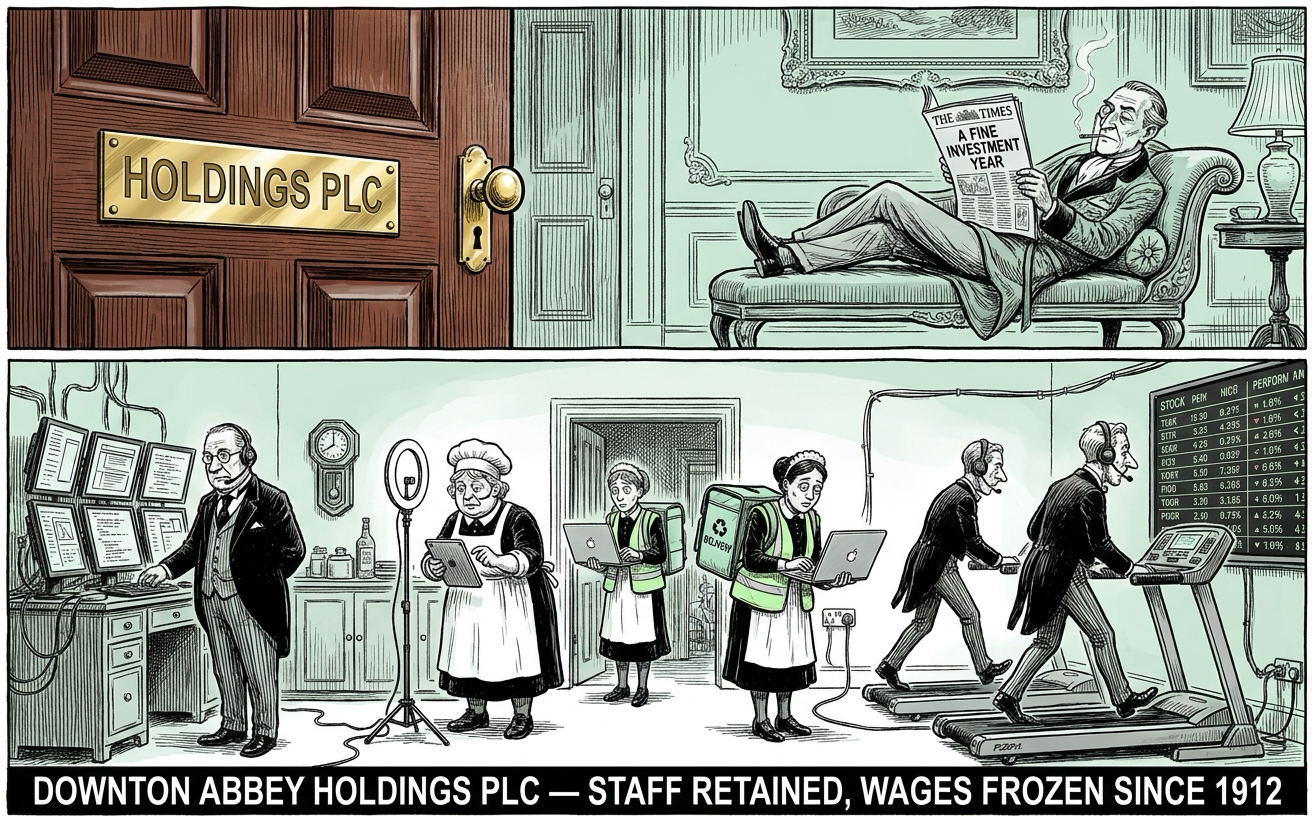
The British social system is still the Downton Abbey arrangement. We just split up the manor. This is Downton with a holding company.
A tiny group owns the productive asset. In 1912 that was the estate. In 2026 it’s housing, equities, intangible IP, the holding company in Mayfair, the trust in Jersey. A larger group services the asset. In 1912 that was the servants below stairs. In 2026 it’s the PAYE professional class, paying their rent and their mortgage interest and their council tax and their employer pension contribution into the same machine the Crawleys used to run, with marginally better lighting. And a floor of beneficence. In 1912 that was the village poor — the tenant farmers, the recipients of the squire’s discretionary charity. In 2026 it’s the UC claimant, kept just functional enough that the arrangement doesn’t get questioned, but never quite functional enough to compete.
The whole structure dressed in elaborate cultural machinery. Manners, deference, aspiration, hardworking families, broad shoulders. The Edwardian version made it feel inevitable through class etiquette. The 2026 version makes it feel inevitable through GDP figures and ministerial soundbites. Same effect.
Now, the honest version of the numbers, because this is where lazy versions of my argument fall over. In 1912 the top 1% owned something like two-thirds of the nation’s wealth. Two world wars, the tax state and the post-war settlement flattened that to under a fifth by 1980 — the single greatest levelling in British history, and it was real. That levelling is the thing the whole essay turns on, so hold onto it. Because the number today is back up to roughly 21%, and climbing.
We spent a century dismantling the Edwardian distribution and the last forty years quietly rebuilding it. On paper, financial wealth is only part-way back. On land — the original Downton asset — we barely left at all.
Under 1% of the population — roughly 25,000 people and corporations — owns about half of England. The aristocracy and gentry alone still hold around 30% of it. Every home-owner in the country, all of us put together, owns 5%. That is not a distribution we drifted into. That is the estate map of 1912 with the fonts updated.
The manor never closed. It just got financialised — and we got upgraded into more sophisticated servants.
Right to Buy was the masterstroke. Sold as empowerment to working-class council tenants — who became, in a single transaction, owners of a tiny piece of the asset class the whole structure depends on. Now their pension is the house price. Now their child’s deposit is the house price. Now they have a financial interest in housing scarcity. Now they vote against new building, against social housing, against anything that would flatten the asset curve they’re climbing. Sold as empowerment. Was capture.
The pattern repeats. Auto-enrolled pensions tie the median worker’s retirement to FTSE performance — the same asset class as the top 10%. Buy-to-let ladders turn middle-class earners into landlords of working-class tenants inside twenty years. The middle class wasn’t liberated from the servant role. It was upgraded into a more sophisticated version of it, with a financial interest in defending the structure it serves.
The genius of the post-war settlement wasn't dismantling the manor. It was giving the servants enough of a stake that they'd defend it.
VI. The Charity Plc Laundering Operation
I want to walk through one specific mechanism, because it’s the one I find hardest to look at without flinching.
We run a roughly £90 billion-a-year charity sector in the UK. A large slice of it is funded by government grants. Much of the rest comes from donors who receive tax relief on their giving — which reduces government revenue. Gift Aid alone costs the Treasury around £1.5bn a year in forgone receipts.
The actual flow is:
- Government underfunds statutory provision. The food bank exists because UC doesn’t cover food.
- Charities form to fill the gap. Trussell. Shelter. Crisis. Citizens Advice.
- Government then funds the charities to do what government could do directly.
- Charities run fundraising campaigns, costing 15-25% of the money raised, to top this up.
- Donors top it up further, claiming tax relief, reducing the government revenue available to do step 1.
- The aggregate cost is higher than just funding the statutory service would have been.
- But it looks like generosity rather than tax, which is politically preferable.
Three million emergency food parcels last year, from a single charity. This is not a charity-sector success story. This is a state failure with a fig leaf on it — run at a higher aggregate cost than just paying enough UC to cover food, but distributed across a million voluntary acts of donation rather than one collective act of taxation, so that nobody has to admit what they’re paying for.
Charity Plc isn’t an accident. It’s the politically preferred way of paying for things the state has chosen not to be seen paying for. The volunteers at the food bank, the donors topping up the JustGiving page, the corporate sponsorship deals — in aggregate, they are doing the work of a tax system. The government has outsourced the moral weight of letting people fall. The donor class gets to feel virtuous about funding what their taxes were supposed to fund anyway. The recipients get to feel grateful instead of entitled. Everyone, very politely, agrees not to notice.
VII. Where I’d Push Back Against Myself
Now the bit I should have done five years ago: steelman the position I’m arguing against. Because the British welfare state, by international comparison, is not the worst version of this on offer — and if I skip that, this is just a rant with charts.
The NHS still works. Free at the point of use, the most genuinely Beveridgean piece of the original settlement, and despite a decade of underfunding it still delivers care to a four-year-old with a heart defect in twenty-four hours that would bankrupt the same family in the United States. That is a real thing. That is not nothing.
Child poverty is lower than in the US. Pensioner poverty has fallen sharply over thirty years. Life expectancy is among the highest in the OECD, even after the post-2010 stagnation. The bottom 50% in the UK live materially better than the top 10% did in 1912 — hot showers, antibiotics, Netflix, cheap flights, secure food supply. The absolute position is so much better that the relative position rarely lands.
Means-testing, even at its worst, is not the same as cruelty. Every developed country attaches conditions to unemployment support. The 55% taper, painful as it is, is a real attempt at the right problem — avoiding the cliff edges where earning one more pound costs you all your benefit at once. The five-week wait is a design choice, not a malicious one — it reflects a monthly-in-arrears system built to match real-world payslips. You can hate the implementation without disputing the underlying intent.
The political comparators are mostly worse. US healthcare. French youth unemployment. German energy. Italian public debt. The “at least we’re not them” framing does a lot of heavy lifting, but it isn’t factually wrong — by international standards the UK is a middling-to-better-than-middling welfare state, not a uniquely defective one.
I’ve held all of these positions. I’ve made all of these arguments, to people I thought were being unfairly harsh on the system I worked inside. Some of them have stayed true. The thing that flipped me was realising that all of these are mostly arguments against radical change, not arguments for the current settlement. They tell you it could be worse. They don’t tell you it shouldn’t be better. They are, with the gentlest possible framing, the comfort threshold doing its job — making the relative comparison feel petty next to the absolute one, and thereby keeping the absolute one stable.
And the comparators get worse every year. The bottom 50% live better in absolute terms, but their position relative to the housing they need to rent, the pension they need to save, and the future they need to plan around is sliding. The absolute floor is rising slowly. The structural ceiling is rising much faster. The gap between the two is the thing the system is built to make sure you don’t notice.
You don’t get to be reassured by being told the trajectory beats Mississippi’s. You get to ask whether the trajectory is acceptable for the country you actually live in.
VIII. Why It Doesn’t Collapse
The obvious question — and it took me embarrassingly long to ask it properly — is: if all of this is true, why don’t people revolt?
The standard answer is coercion. Police. Prisons. Surveillance. It’s part of it, but it’s not the main part. The main mechanisms are subtler.
The Five Stabilisers
Atomisation
The servants in 1912 lived together below stairs and shared an identity. Modern workers live alone in flats, work remotely, and organise through algorithms designed to fragment them. You can't form class consciousness on a platform engineered to make you fight your colleagues about pronouns.
Identity substitution
Political energy that would once have been class-based gets redirected into identity politics (left) and culture war (right). Both genuinely care about their issues. Neither touches the ownership structure. A monarchist drag queen and a republican plumber have more economic interests in common than either has with their cultural allies. Neither knows it.
The plausibility of mobility
Enough people climb that the ladder seems real. UK intergenerational mobility is among the worst in the OECD by the numbers. Anecdotally, everyone knows someone who made it. The anecdote drowns the statistic.
The comfort threshold
The bottom 50% live materially better than the top 10% of 1912. Hot showers, antibiotics, Netflix, supermarket food, the smartphone in your pocket. An absolute position that good stops the relative one registering as a grievance.
The exit valve
The genuinely capable from the lower classes get promoted into the professional infrastructure. University, the graduate scheme, the mortgage, the pension. This drains exactly the people who would otherwise organise the bottom.
The Crawleys don’t need to defend the manor. The servants defend it for them, in exchange for slightly better quarters. The PAYE professional class — most of the people who read this, me, you, probably — is the engine of stability for an arrangement we are not, on balance, the beneficiaries of. We service the asset because the asset has been arranged so that servicing it is the only way to stay housed.
IX. The Quiet Erosion
The original Lockean pitch was that we consent to government because it provides what we can’t provide ourselves. Roads. Defence. Courts. Education. Healthcare. A floor of human dignity. The modern test of legitimacy is whether the things government provides are worth the things we give up — taxes, the conscription of our consent, the slow accretion of rules.
For Sarah, the answer is becoming no. Not in any revolutionary sense. Just in a quiet, accumulating, this isn’t a serious country any more sense.
For me — middle-class, mortgaged, employed, the demographic ostensibly winning under this arrangement — the answer is also becoming no. Slower. Quieter. But the same direction.
You can hear it in the way pubs in Bromley talk about the conversation that’s not happening in Westminster. You can hear it in the way people my age, asked where they see themselves in ten years, mention Portugal or Greece or Bali with a frequency that would have been bizarre in 2015. You can hear it in the polling. You can hear it in the silence around the polling.
What you cannot hear is anyone in the building admitting it.
You'd find more honest discussion of this in a pub in Bromley than in any green room in Westminster. Which is probably the most damning bit.
X. The System Is Working As Designed
This is the bit it took me too long to admit, so let me say it plainly.
The system is not broken. It is not failing. It is not in need of reform. It is working exactly as it has always been intended to work.
It produces: a tiny ownership class that grows wealthier each generation regardless of merit. A professional class that defends the structure in exchange for slightly better quarters than the servants. A claimant class kept just-functional-enough that the arrangement doesn’t collapse. A cultural apparatus that frames all of this as the natural order. A political discourse that channels every grievance — about immigration, about identity, about culture, about anything except ownership — into safe, non-structural directions.
Asking whether the system is broken is the wrong question. The system is doing what it does, with impressive consistency, at low political cost, with the consent — manufactured or not — of most of the people inside it.
The right question is the one Westminster won’t ask:
Is this the country we want to be?
If it is, then we should stop pretending we’re shocked when the contradictions surface — when food banks scale, when the 35 cliff edge bites someone in your family, when a working friend can’t afford a flat. They are the system functioning, not failing.
If it isn’t, then the conversation we need to be having is not about Universal Credit reform. It’s about the underlying ownership structure UC was designed to manage rather than challenge. Which is the conversation nobody, on either side of the aisle, will start.
I spent a decade working on the part of the system that sits downstream of that conversation never happening. I’m going to spend the next decade arguing that we have to start having it.
The Cliffhanger
If the system is working as designed, and the design isn't going to change, and you happen to be one of the 33 million of us who get up and prop it up every morning with your labour and your rent and your council tax and your consent —
what exactly are you doing here?
That's the next post.
This piece is part 1 of 2. Part 2 — Warmer Than Margate — argues that the rebellion that actually changes the structure isn’t fought from inside it.
Data referenced: Office for Budget Responsibility (Universal Credit spend ~£83bn/year, government borrowing ~£130bn/year, dependency-ratio projections); DWP and the Universal Credit Regulations (standard allowance, Local Housing Allowance, the Minimum Income Floor, capital and surplus-earnings rules); ONS Wealth and Assets Survey, adjusted for its known under-coverage of the very wealthy (Resolution Foundation / World Inequality Database) for the ~21% top-1% and 57% top-10% shares; Alvaredo, Atkinson and Morelli for the long-run top-1% wealth series (~67% in 1914, under a fifth by 1980); Guy Shrubsole, Who Owns England? (2019), plus Land Registry data, for land ownership; Trussell Trust 2024-25 annual report (~3 million food parcels); HMRC (Gift Aid forgone revenue). The specific UK figures are 2024-2026 published values; the framings — and the over-statements — are my own.