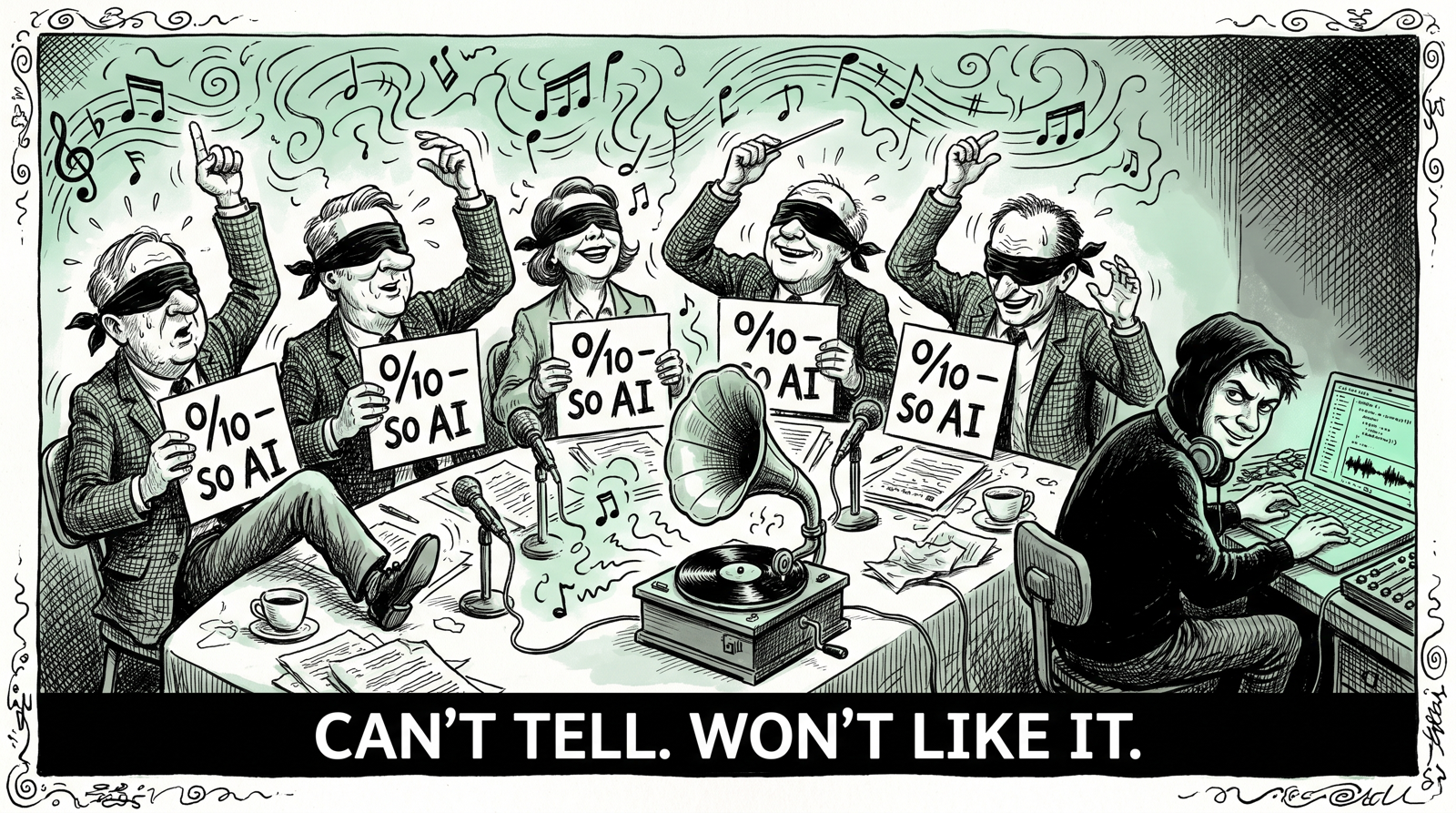
“Oh, it’s soo AI.”
“That’s shit. You can tell it’s AI.”
In May 1975, Pepsi set up a folding table in Dallas, poured two unmarked cups of cola, labelled one M and one Q, and asked Coke drinkers which they preferred. About half picked the Pepsi. It became one of the most famous adverts ever made, and for the next decade Coke kept outselling it anyway.
Okay, this is a bit delicate, but I want to bring back the Mitchly Challenge. It’s the Pepsi Challenge for music: AI and independent tracks side by side in unmarked cups, and you say which you like before anyone tells you which is which. Delicate, because I co-founded Mitchly with Rosie, and people make AI music on it, me included. So I should say where I’ve landed, and why I think the cups matter more than the people in the comments do.
Here’s the position. AI doesn’t steal jobs, and it doesn’t make music. People do. The thing everyone is sneering at is a tool, and the thing it can’t do was never about how the music sounds in the first place.
The Unmarked Cup
Start with the sip. Late last year Deezer and Ipsos played 9,000 people in eight countries three tracks, two of them made entirely by AI, and asked which were which. 97% got it wrong. More than half said not being able to tell made them uncomfortable.
Then mark the cups. Researchers have played people the same piece of music twice and changed nothing but the label, and the version called “AI” gets liked less: classical pieces said to be composed by a computer, the same piano recording credited to a pianist or to a machine. A study written up this May put money on it. Played blind, listeners rated the AI songs better, right up until they were told what they were. After that they were less keen to play them again and less willing to pay. Paintings get the same treatment: label one “AI-made” and it’s liked less and judged to be worth less, even when every painting in the test came out of a machine. (I went down this rabbit hole at length in The Grass Is Always Greener on the AI Side.)
So people legitimately can’t tell, and they rate the human thing higher even when it’s the AI thing. We can’t hear the difference, but we’re sure we don’t like it. That’s not an ear for music. It’s snobbery with headphones on.
The Auto-Tune Theory
True artists have always pushed the envelope of any new tool, to see what it can do and how they can use it in artistic expression. The synth, the drum machine, the sampler, techno, the bedroom studio on a laptop. Every one of them was going to be the end of real music at some point.
Auto-Tune is the good example. It was built in 1997 to fix wonky notes without anyone hearing it. A year later Cher’s producers turned it all the way up on “Believe”, the first big hit to use it as a sound on purpose, and it was edgy, new, innovative. Then a decade of shitty SoCal wannabes pumped out Rebecca Black-esque “it’s Friday” songs with it, and yeah, it killed it. The fans reacted appropriately. By 2009 Jay-Z had put out a single called “D.O.A. (Death of Auto-Tune)”.
The tool survived; plenty of the music you love today has it on. What died was using it to skip the hard part.
(P.S. No shade on Rebecca Black. I have nothing but the utmost respect for her. It is so insanely cruel, and unimaginably difficult, to be the butt of the world’s jokes to this day, and she was thirteen. Mad respect to her for sticking it out and embracing the meme. And yeah, she is a good singer with good tracks: go and listen to her latest album, Age of the Exhibitionist.)
AI is in the “Believe” phase and the “Friday” phase at the same time. Some people are doing strange, brilliant things with it. Far more are using it to pump out the soundalike stuff, and that’s what the sneer is really aimed at. Fair enough. But it’s aimed at the laziness, and it keeps hitting the tool.
All the Opinions
Here’s the thing: it’s easy to criticise music, it’s difficult to make it. And truly good music isn’t always about pitch, or tone, or whether it gets stuck in your head, or whether it makes bachelorette parties woooo on their way to the dancefloor at 2am.
To make truly good music you have to be creative, and you have to believe in yourself enough to put yourself out there despite the inevitable critics. To connect with fans, your music has to come from somewhere. It has to mean something to you before it can mean anything to anyone else.
That’s the part AI can’t replicate, because it doesn’t have life experience to draw on. It inherently doesn’t have an opinion. It has all the opinions. So it knows what mathematically sounds best, maybe, but not what will make the hair stand on end.
It doesn't have an opinion. It has all the opinions.
It can, and will, be used to churn out generic radio hits you tap your foot to and sing along with: notably only while alone, in the car or the shower, for most people. Most of us won’t sing in front of anyone, which tells you something about the bravery of the people who do it for a living.
Like Auto-Tune, the fans will get tired of it. Not all of them, and not in every mood. There’s a time and a place for the tap-your-foot, mean-nothing summer party anthem everyone knows. But nobody is a fan of that song, and they’re definitely not fans of whoever made it. In the modern music economy most people have no idea who wrote their favourite hit or who produced it. They maybe know who eventually agreed to perform it, and no shade on them either: the performance is what made it a hit, and that’s a special talent all of its own. The singer was just never the only person in the process with any.
This is where the cola comes back. In 1985 Coca-Cola ran blind taste tests on nearly 200,000 people, found a new recipe that beat the old one, and launched New Coke. The public revolted, and the original was back on the shelves as Coca-Cola Classic 79 days later. Malcolm Gladwell’s explanation was that a single sip rewards whatever is sweetest, which isn’t what you want from a whole can. Nobody missed the taste of old Coke. They missed what it meant to them.
Blind tests measure the sip. Fans buy the can.
Without Their Consent
None of which gets my side off the hook. The collective works of the greatest singers, songwriters and musicians made AI music possible, arguably without their consent or compensation. They all contributed to it in some way, and so did the fans who made that music popular and carried it around the world. If AI has all the opinions, it’s because it took them from somebody.
It’s a symbiotic ecosystem where fans meet artists, and it isn’t unique to Taylor Swift, even if she gets the most notoriety. There are die-hard fans of dwarf metal. Of progressive rock bands with twenty-minute technical masterpieces. Of bands that have long since passed, of pop stars, of underground grimy punk rockers, and of grunge bands back on stage twenty years after their lead singer died.
Not all music is remembered forever, or even lasts a summer. But you’d be surprised how a song you have never heard of can bring someone else to tears, transport them back in time and place, and unlock a box of emotions they haven’t felt in years. That’s what makes music special, and that’s what makes artists artists, no matter if they sing a cappella, use Auto-Tune, have a ghost co-writer, use music production software or, yes, use AI to create their art.
So the honest answer to “it was built on artists without paying them” isn’t “no it wasn’t”. It’s to pay them now.
Quit Your Day Job
I’ve got skin in this beyond Mitchly. Writing used to be my livelihood, and I’ve watched Rosie use AI to write without thinking twice, the way you’d pick up a pen, for exactly the kind of work people used to pay me for. Where I’ve landed is the same place as with music: the words worth reading came from somebody who had something to say, and the tool was never the part that had it.
Which brings me to VOSS, my AI alter ego on Mitchly: dark pop, one album so far, CORNERED, fourteen tracks. I’m a person. I made it. I didn’t sing it. Somebody had the idea, picked the sound and threw out the versions that meant nothing. Very much not AI slop.
And we do believe in paying artists for their work, because we think it’s a job, despite all the starving-artist cultural memes. That’s why part of the sale of every extra AI album on Mitchly goes to promoting independent artists around the globe. It’s why Mitchly was founded in the first place: to connect real artists with their fans, wherever they are, so they can be paid by the people their music means the most to, and ultimately to let them have success, be recognised for their talents and… yes… quit their day job!
The unglamorous bit is yours, and it’s two steps. Pick the song before you ask who made it. Then pay the person who did. The second step matters more, because it’s the one the sip test can never measure.
The Bottom Line
Pepsi won the taste test and Coke won the country, because people were never buying the sip.
AI can win the sip. It has all the opinions. It just doesn't have one, and that's the bit that makes the hair stand on end.
Think you can tell? Take the Mitchly Challenge.
This post started as a rant about bringing back the Mitchly Challenge, and a point I keep making to Rosie about who gets to use AI for what. Data referenced from the Deezer/Ipsos AI music survey (2025); Shank et al., Journal of Experimental Psychology: Applied (2023); Ansani et al., Empirical Studies of the Arts (2025); Friedrichsen, Schwarz and Clement on ProMarket (2026); Bellaiche et al., Cognitive Research (2023); and Coca-Cola’s own history of New Coke. The opinions are my own.