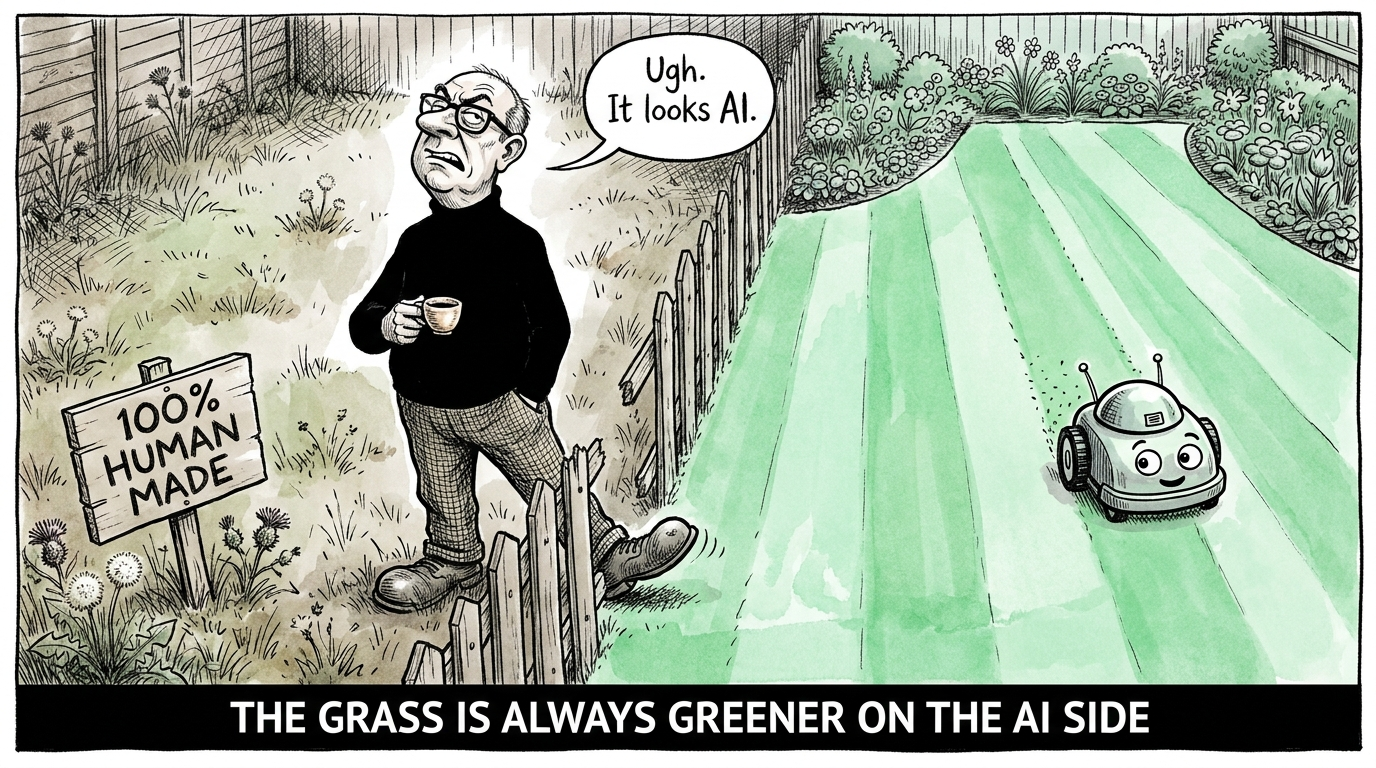
Hypocrisy and democracy grew up in the same town. Athens got its democracy from Cleisthenes in 508 BC, and within a century its theatres had a word for the man on stage playing a part: the hypokritēs, the actor. It took the Greek Bible to turn the actor into a moral failing, but the thing itself is older than the word and the vote. People have been saying one thing and doing another for as long as there have been people and things.
We are on a collision course with a point of divergence in human history, and it comes down to six words: either hypocrisy goes, or we go.
Start with the word, which nobody likes. Hypocrites are the annoying people, the sleazy people, the ones who talk out of both sides of their mouth. They are also something almost all of us are, myself included, if, well, we can be honest with ourselves about it. Which, being hypocrites, we mostly can’t.
Many of you cringed there. We really, really don’t like being seen as one, thought of as one or called one. It’s a dirty word, and it rubs us up the wrong way, because we know it’s true.
For 2,500 years the gap between the person we say we are and the person we actually are has been survivable, because nobody could see all of it at once. Then we built a machine out of all of it. Now we stand in front of the things it makes (the website, the song, the illustration, the perfectly diplomatic email) and deliver the review of the decade: it looks AI. We say it as if we’ve caught a fake. What the machine shows us isn’t fake. It’s us: what we actually like, rather than what we say we like. And we can’t stand it.
In Your Own Best Interest
The English language is full of idioms, everyday phrases and conversational nuances that exist only to help us manage our own hypocrisy. The white lie: a lie, in a nicer colour. Cutting off your nose to spite your face: doing the stupid thing on purpose, knowing it’s stupid. In your own best interest, the phrase that announces someone else has already decided. The habit of ignoring advice from every friend and relative who loves us, then doing exactly what they said the moment a stranger says it. (I’ve written before about how people will take from a disinterested stranger the point they’d never take from family.) Or caring deeply about data privacy and security, and using one password for everything.
That last one comes with receipts. LastPass surveyed 3,750 professionals in seven countries in 2021: 92% knew that reusing a password was a risk, and 65% always or mostly did it anyway. Pew found 81% of Americans worried about what companies do with their data, and 56% clicking “agree” on privacy policies without reading them.
Entire business empires have been built on the gap. Self-help is a $12bn industry in America alone. Then there are the apps that help us manage our time better. Ahh, what a lovely, nice-sounding phrase. Daily habit builders. Time trackers. Motivational, goal-orientated apps to achieve success, and an endless assortment of gym trackers. In HR they invented the 360 review, in the endless pursuit of managing our own entrenched hypocrisy: if you won’t tell yourself what you’re like, eight colleagues and an anonymous form will.
We think of ourselves as health-conscious, vegan, soya-drinking gym enthusiasts. We haven’t been in two years, and we choose the pizza when no one is watching. When two economists followed 7,752 members of three American gyms, the ones paying a flat fee of over $70 a month turned up 4.3 times a month: more than $17 a visit, when a ten-visit pass would have cost them $10 a go. They would have saved $600 over their membership by admitting how often they actually went.
Hence all the apps to trick us into doing the things we say we love and want to do. We need apps to trick us, into being the person we already tell everyone we are.
Economists have had a name for this since 1938, when Paul Samuelson proposed judging people by what they choose rather than by what they say they’d choose: revealed preference. For most of history, revealed preference was private. You knew about the pizza. The gym knew about the direct debit. Nobody had the whole catalogue in one place.
The Grass Is Always Greener
AI is us. Everything we’ve written, said or done over hundreds of years, catalogued and tracked: the books and the forum rows, the five-star reviews and the one-star rants, the websites that worked and the ones that didn’t. It knows what we read, clicked, bought, finished, shared and came back for, which is rarely what we claimed to like.
It is why it can write the best SEO blog. Make images we like. Songs we think sound good. Websites that look nice. Emails that sound diplomatic. It holds the revealed preferences of a few billion people, collected while nobody was watching.
Psychologists found a small version of this in 1990. Judith Langlois and Lori Roggman blended photographs of real faces into composites and asked people to rate them. The averaged faces came out more attractive than almost every face that went into them, and grew more attractive the more faces were added. The average of what we like is, it turns out, what we like.
So here is the trouble with it looks AI. Put people in a blind test and they mostly can’t tell. If they say they can, they’re lying to you or to themselves.
In 2022 Sophie Nightingale and Hany Farid showed 315 people a mix of real faces and AI-generated ones. They picked correctly 48.2% of the time, which is a coin flip with extra steps, and a separate group rated the AI faces 7.7% more trustworthy than the real ones. In 2024 Brian Porter and Edouard Machery gave 1,634 people poems by Shakespeare, Chaucer, Byron, Whitman, Dickinson, Eliot, Plath and others, mixed with poems ChatGPT had written “in the style of” each. Readers spotted the AI poems 46.6% of the time, below chance. They were more likely to think the machine’s poems were human than the real ones, and in a second study they rated the AI poems higher on 13 of 14 qualities, from rhythm to beauty. Originality was the only one where the humans held their ground, and even there the difference wasn’t significant.
Music fares no better. In a Deezer/Ipsos survey of 9,000 people in eight countries, Britain among them, 97% failed a blind test of three tracks, two of them AI. And the confidence runs well ahead of the skill: when the identity firm iProov tested 2,000 people in the UK and US on real and fake images and video, 0.1% got every one right, while more than 60% were confident they could.
What does move us is the label. In 2023 Lucas Bellaiche and colleagues showed people 30 paintings, every one of them made by AI, and told them at random that each was “human-created” or “AI-created”. The ones labelled human were liked more, found more beautiful and more profound, and judged to be worth more. Porter and Machery found the same with their poems: tell readers a poem was written by a person and its ratings went up.
"It looks AI" isn't a review. It's a confession.
So when someone says a thing looks AI, what they mean is that they don’t like the culmination of all best practice: what all the data says people do like. It looks like what everyone actually likes, them included, until they were told who made it. It’s the greener grass on the other side of the fence, and we’re standing on our patchy side with a tiny coffee, announcing we’d never.
There is a version of the sentence that’s a fact, and I’ve typed it myself: that’s AI, about an AI-generated girl in a reel built to farm outrage, posted to a group chat I’m in. That one was a claim about where a thing came from. It could be checked, and it mattered, because a fake person is a lie. It looks AI is a different animal. It’s a taste wearing a fact’s coat.
There’s one version of it looks AI I’ll grant, and it isn’t about AI at all. Sometimes it means it looks like everything else: the same hero banner, the same one word in italics, the same pill-shaped button with an arrow in it, whether the page sells bike repairs or research software. A friend spent a whole day benchmarking the instruction sets people feed AI to stop it looking AI. The ones that came with a house style turned a bike shop and a researcher’s app into the same page, twice. The anti-slop rules had hardened into a new slop. That’s what averages do, and humans got there first: every tech site of 2018 had the same flat cartoon people with long purple limbs and tiny heads. Less AI never fixed it. More of the subject does: the bike shop’s own spoked wheel, the researcher’s own transcript, the thing only this one could show. Sameness is a fair complaint. It just isn’t the one people think they’re making.
Leopards Ate My Face
In October 2015 the writer Adrian Bott posted what became one of the internet’s most useful sentences: “I never thought leopards would eat MY face,” sobs woman who voted for the Leopards Eating People’s Faces Party.
I’d put money on the person who says a website “looks AI” having spent the 2010s championing best-practice UX. Clear hierarchy. Generous white space. One call to action per screen. Test everything, and let the data decide. And the data did decide. A decade of A/B tests, design systems and conversion audits sanded the web down to the version people actually use, and then the whole web went into the training data. The machine learned the consensus perfectly and now produces it on request in about a minute. The people who built the consensus look at it and say it looks AI.
The purest specimen is a colour. In August 2025 Adam Wathan, who created the Tailwind CSS framework, posted: “I’d like to formally apologize for making every button in Tailwind UI bg-indigo-500 five years ago, leading to every AI generated UI on earth also being indigo.” He was joking, mostly. But the most recognisable “AI look” on the web is a default a human picked because it looked good, which a great many other humans then copied because it worked.
They voted for the leopards. And it doesn’t stop at websites. It applies to almost anything subjective: “it reads like ChatGPT” mostly means the writing is clear and has a structure; “it sounds AI” mostly means the chorus arrives on time. AI exposes all of it in a way we are truly not ready to deal with.
The Emperor’s New Earbuds
We’ve rehearsed this before, on a smaller stage. Remember the audiophiles: lossless FLAC only, never a 320kbps MP3, and the whole collection played on the Northern line through the stock white iPod earbuds. UCL researchers have measured sections of the Northern line between Camden Town and Euston at almost 109 decibels, which is a lot of decibels to hear the difference between two file formats through.
The preference was an identity, and audio quality had very little to do with it.
The audiophile, though, at least made a claim you could check, and the blind tests have been embarrassing the hobby for years. In 2007 E. Brad Meyer and David Moran ran 554 blind trials with members of the Boston Audio Society, pitting high-resolution audio against plain CD quality: 276 correct, or 49.82%. A 2009 McGill study found trained listeners preferred CD quality over MP3 only up to 192kbps; at 320kbps the preference disappeared. That was in a lab, not between Camden Town and Euston. Sound quality is objectively provable, or disprovable, whether or not he accepts the result. Taste was never like that. Nobody could blind-test whether a website was good, so it looks AI, like it looks cheap and it looks basic and it looks try-hard before it, could pass a status judgement off as a quality one.
Fashion runs on this. Why is a Hollywood star in a dishcloth high fashion, and a normal person wearing one a homeless person? Balenciaga has sold a $1,790 leather pouch styled as a bin bag (2022), a $925 skirt that was, to the naked eye, a bath towel (2023), and a $2,145 tote so like IKEA’s 99-cent blue FRAKTA bag that IKEA ran a spoof advert explaining how to spot the original: it rustles when you shake it (2017). On the right person, iconic. On anybody else, bin day.
Or, at the less extreme end: what we call good fashion sense mostly means someone who copies what they’re told to wear, and does it well. Bad fashion sense means someone who doesn’t know, or doesn’t care enough. And if the person is socially superior, whatever they wear is iconic and good style. The garment never changed. The wearer did.
These are deep-seated hypocrisies, and AI lays them bare more each and every day, because humans previously got away with blurring the subjective and the objective. I don’t like it got to dress up as it’s bad. A machine that makes the thing everyone measurably likes, on demand, then sits in a blind test while we fail to spot it, takes the costume away.
Cutting Off Your Nose
There’s a hole in all this, and it’s a big one. If exposure killed hypocrisy, the liars, the scammers and the charlatans peddling their non-facts should have been the first to die from AI, and before AI, from the internet. Nearly everyone you know carries all the information they could ever want in their pocket. Sadly, one of the most famous is back in the White House. Vaccine denial didn’t die either. America recorded 2,289 measles cases in 2025, its most in more than 30 years, and three people died, two of them unvaccinated children in Texas. By the start of October this year it had passed 3,800. The evidence was a tap away the entire time.
By my own logic, then, AI should be no more fatal to hypocrisy than Google was to lying, and on its own it won’t be. The audiophile already proved it. You could disprove him with a blind test in an afternoon, and the FLAC collection would survive untouched, because you can’t fact-check someone out of an identity. People have to convince themselves.
What AI changes is whose evidence it is. The vaccine evidence was about the world, so it could be waved away as somebody else’s agenda. The blind test is about you: what you picked, and how you rated it before you saw the label. It’s harder to call your own preferences a conspiracy. Harder, not impossible. In the Deezer survey, 52% said they were uncomfortable at not being able to tell the difference, and 80% wanted fully AI-made music clearly labelled. Some of that is fair: people deserve to know what they’re paying for. Some of it is wanting the label back, so we know what to think.
So this is a fork, not a forecast. AI doesn’t make anyone look in the mirror. It just makes the mirror very large and hangs it everywhere.
The Point of Divergence
Either hypocrisy goes, or we go. Here’s what I mean by the second half.
If your taste is borrowed (the coat you were told to wear, the music the right people listen to, the opinions of the group you’d like to be in), then you are an average of other people’s preferences. That is the one thing the machine does better than anyone alive. It is the average of everyone’s borrowed taste, with perfect recall and no ego. Compete with it on those terms and you lose, and the thing that replaces you is the thing you said you couldn’t stand.
What it can’t do is the part underneath. Opinions are not identity. What’s yours is how you formed them, which is something deeper than the opinion itself. You can latch on to someone else’s identity; the machine can latch on to everyone’s at once.
The way out isn’t complicated. Accept that there is nuance in everything, that taste is subjective, that things are not black and white, and that saying so isn’t weakness. The practical version is small enough to do tonight. Decide whether you like it before you ask who made it. And when you don’t, say I don’t like it. Not it’s bad, and certainly not it looks AI. Four words, said out loud, that keep the subjective and the objective apart, which is the one job the hypocrisy was quietly doing for us.
The Greeks had a word for someone playing a part. For 2,500 years we’ve played ours off stage, because nobody had seen every performance. Something has now.
The Bottom Line
The next time something "looks AI", finish the sentence honestly: it looks like what we all actually like, you included, right up until someone told you who made it.
Opinions aren't identities. What's yours is how you got there.
You can't latch on to someone else's identity and call it your own.
So, be honest. Did you like it? The cartoon: did that look nice? Or did it look a bit… you know… AI?
Did I sound a bit AI?
Was this whole thing written by one? But you liked it. You thought it made some good points. So it can’t have been. Could it? Even this bit? And if it was… what does that say about the post? About its point? About you?
Nothing. No need for an identity crisis.
But then again, I would say that… eh? I… would say that, wouldn’t it?
#AISlopOut 😎
This post started as a blog dump and a voice note that cut off halfway through, which is about as honest as a first draft gets. Data referenced from LastPass, “Psychology of Passwords” (2021); Pew Research Center, “How Americans View Data Privacy” (2023); DellaVigna & Malmendier, “Paying Not to Go to the Gym”, American Economic Review (2006); the Humane Research Council (now Faunalytics) study of current and former vegetarians and vegans (2014); Norcross & Vangarelli on New Year’s resolutions, Journal of Substance Abuse (1988); Marketdata on the US self-improvement market (2025); Langlois & Roggman, “Attractive Faces Are Only Average”, Psychological Science (1990); Nightingale & Farid, PNAS (2022); Porter & Machery, Scientific Reports (2024); Bellaiche et al., Cognitive Research: Principles and Implications (2023); the Deezer/Ipsos AI music survey (November 2025); iProov’s deepfake-detection study (February 2025); Adrian Bott (October 2015) and Adam Wathan (August 2025), on X/Twitter; Meyer & Moran, Journal of the Audio Engineering Society (2007); Pras et al., Audio Engineering Society Convention (2009); UCL on Tube noise (2019); Balenciaga and IKEA prices as reported at launch (2017–2023); and CDC measles case counts (2025–2026). The opinions, and the hypocrisies, are my own.