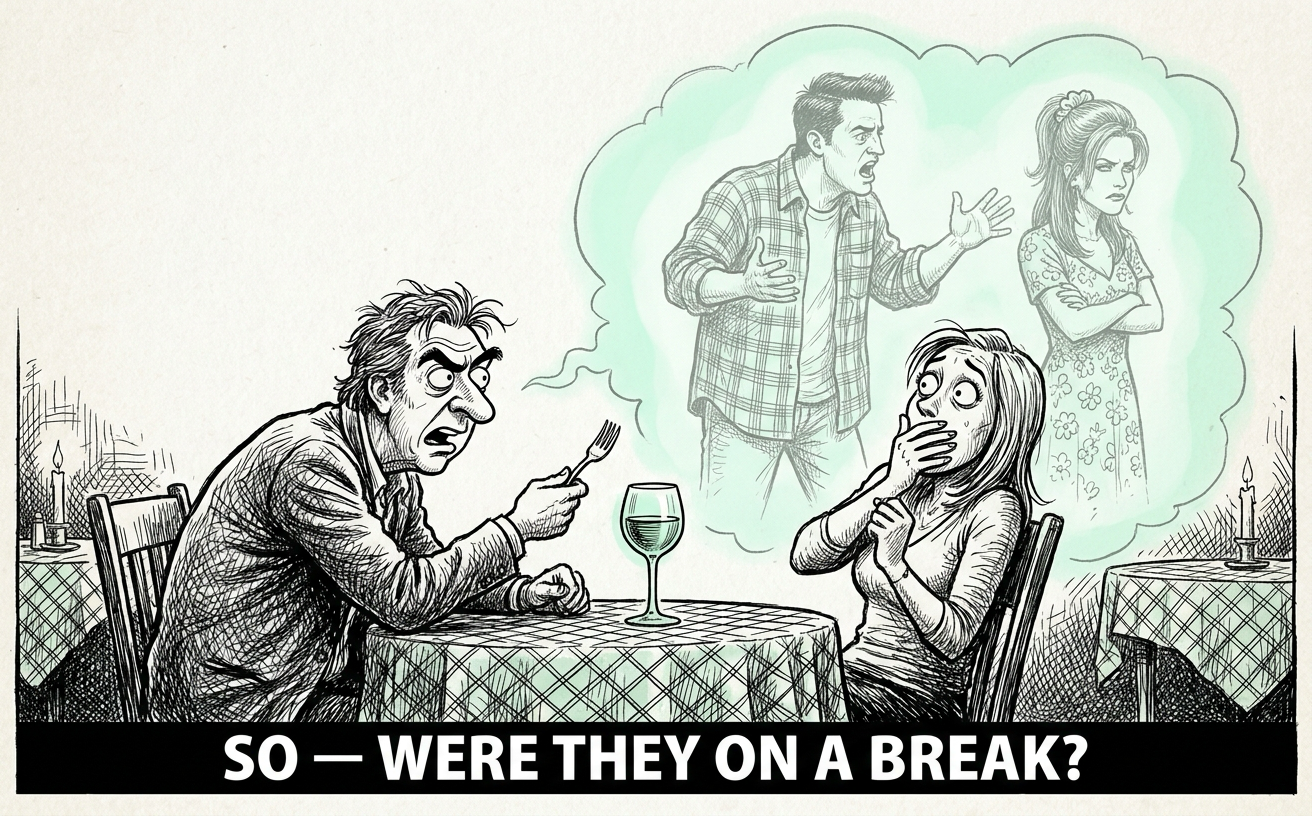
I ask the question on first dates.
Not in the first ten minutes. I’m not a sociopath. I wait until the conversation has found its rhythm and the where-did-you-grow-up has done its work, then I drop it in. Were Ross and Rachel on a break?
The answer is never the point. The point is the reflex. Which version of the answer they reach for first, before they have time to perform. Because the answer to that question — properly considered — is one of the cleanest tells I’ve ever found for what someone actually believes about love. And what they believe about love is what I’m going to have to live with if this works out.
I’m aware this sounds insane. Stay with me. By the end of this you’ll either be asking it yourself, or you’ll be furious with me, and both outcomes are interesting.
Here’s the argument in one line: the question is a Rorschach test for whether the person across the table has internalised twenty-one years of patriarchal romance as the ideal of love, and whether they know they have. Their answer tells me. My answer tells me. Your answer, when you’ve finished reading this, will tell you.
Let’s go.
The setup, briefly
In case you’ve been in a yurt: Ross and Rachel have a fight in season three. Ross has spent weeks losing his mind about Rachel’s male colleague Mark. Rachel — who has finally got a real career at Bloomingdale’s, who has been managing her boyfriend’s escalating jealousy alongside an actual job — tells him, maybe we should take a break from us, and walks out.
Ninety minutes later, Ross sleeps with the girl from the photocopy shop.
The next morning, he sprints around Manhattan trying to bury it before she finds out.
The truth comes out. The relationship implodes. For the next seven seasons, every time they argue, one of them reaches for we were on a break. The writers kept mining the joke because they knew they’d hit something. What they’d hit was that the question is genuinely unanswerable on its own terms. There’s a legal reading and a moral reading and they give you different answers.
The Diagnostic
Did Ross break a specific rule?
No. Rachel said the words. A break from us is the suspension of the relationship. Ross was technically single, and single people can sleep with whoever they want. End of story.
Did Ross behave like the man he claims to be?
Also no. A man who'd loved Rachel since the 9th grade doesn't end up in bed with the photocopy girl ninety minutes into a fight. And people who've done nothing wrong don't spend the next morning sprinting across Manhattan bribing strangers into silence.
The moral reading, in full. This is a man who, by his own framing, had loved Rachel since the 9th grade. The lobster. The destiny. The cosmic-love-of-his-life. A man for whom that framing is true does not, ninety minutes into a fight, find himself in bed with the photocopy girl. He goes home. He sits with it. He drinks too much and feels terrible. He waits for the phone. He doesn’t, the morning after, run from the Xerox place to a barista trying to bribe a chain of near-strangers into silence — because a man who genuinely believed he was single would have nothing to bury.
The cover-up is the tell. People who’ve done nothing wrong don’t behave like people covering things up. Ross’s first instinct was concealment, which means his first instinct was the awareness that what he’d done wouldn’t survive being known. The we were on a break defence comes later. It’s the technicality he reaches for once he needs one. It’s not the position he held in the moment.
An aside, because I got this wrong. When I first drafted this, I’d have bet the house that Ross sent Rachel flowers that morning. I could see them. I wrote a whole paragraph about the airbrushing power of a next-day bouquet. Then I went to check the tape, and — nothing. No flowers. He spent that morning sprinting from the photocopy place to Gunther’s counter, trying to bribe everyone who might talk into keeping quiet before Rachel could hear it from anyone but him.
The roses I was picturing were real. They just went to a different woman. Ross sends seventy-two of them to Emily — one for every day he’d “known and loved her” — after saying Rachel’s name at their wedding. They come back cut into mulch. Monica offers to make potpourri.
Which is the tell inside the tell. I’d merged his two grand gestures into one memory because the operating system is identical: cause catastrophic damage, then reach for a mathematical grand gesture — seventy-two roses, a frantic morning of bribes — to force the situation back into shape before anyone can look at it too closely. Rachel should have stayed on the plane. Emily was right to get on hers.
Both readings are correct. They answer different questions. Which one you reach for first is the entire diagnostic.
What your answer tells me
If you go they were on a break, end of story — and stop there — you’re telling me you read relationships contractually. You notice specific rules and specific violations. You’re less good at the texture of how things were meant, the spirit underneath the words. Fine. Useful information. But it tells me that when I eventually hurt you, by accident or otherwise, your first sentence will be I didn’t break any rule before I see you’re hurt. That’s a relationship style. Some people can live with it. I can’t.
When I eventually hurt you, your first sentence will be I didn't break any rule before I see you're hurt. That's a relationship style. Some people can live with it. I can't.
If you go technically yes but obviously not, look at what he does the next morning — you’re telling me you read the spirit underneath the words. You can hold the position that someone can be wrong without breaking any rule. That’s the version I want to keep talking to.
If you’re a woman and you go Ross was the romantic, Rachel was lucky he kept trying — I’m not going to be unkind about this, but I’m going to be honest. You’ve absorbed a framework where long-suffering male pursuit reads as love. Where jealousy reads as care. Where intensity reads as depth. The framework is older than you. The framework is older than the show. You didn’t invent it and it isn’t your fault. But it’s the framework that, if I’m in your life long enough, will let you romanticise things you shouldn’t. If I escalate, you’ll call it devotion. If I narrow your world, you’ll call it love. I know this because I’ve watched it happen to women I cared about, and I don’t want to be the person it happens to next.
If you’re a man and you go they were on a break, Rachel was being unreasonable — different problem. You’re the guy who watches Ross and goes literally me. You’re the guy who will defend the picnic basket at her office as a sweet gesture. You’re statistically the guy whose girlfriend finds out in year three that you cannot tolerate her having a career, or male friends, or a personality that exists outside the relationship. I’m not saying every man who thinks Ross was on a break is going to ruin a woman’s life. I’m saying it’s the same framework that produces every Ross out there in the wild, and there are a lot of Rosses out there in the wild.
If you go Joey was actually the most honest man on the show, without me having mentioned Joey — you’ve done the work. I don’t know how, I don’t know when, but at some point you stepped outside the framework and looked at it from the outside. Order another drink. This one might be worth a second date.
That’s the diagnostic. Let me explain why it works.
The pattern
I’ll keep this tight. If you’ve already done this work, skim. The argument continues underneath.
The case against Ross isn’t that any single moment is damning. It’s that the pattern across ten seasons is unmistakable once you stack it up. Ross pursues Rachel hardest at the moments when she’s at her weakest. He recedes when she’s winning. He escalates when she’s growing. His grand gestures don’t celebrate her life — they interrupt it.
The pilot. Rachel walks out of her own wedding twelve hours earlier. No career, no money, no plan. She’s at the lowest point of her adult life. That’s the moment Ross decides to make his move. Monica tells him not to. He does it anyway.
The laundromat. Rachel has never done laundry. Ross volunteers to help. The whole scene is built on her incompetence at a basic adult task and his patient mastery of it. He stands up to the bully woman. He delivers the you did one load, big deal speech. She kisses his cheek. He walks into a pole. Audience: aww.
Strip the music. What you’ve got is a man finding a woman in a state of maximum domestic helplessness, inserting himself as rescuer in a low-stakes arena where he literally cannot lose, and converting her relief into romantic credit. He doesn’t help her with anything that matters — not her career, not her family rupture, not her finances. He helps her with laundry. Because laundry is winnable. The pink-sock failure becomes a running affectionate reference, which means it stays named in the relationship. The bank has been seeded, in their first major scene together, with I knew this thing and you didn’t, isn’t it sweet that I helped you. Over ten seasons that bank gets huge. Every deposit is the same transaction.
The prom video. Rachel, age seventeen, just stood up by Chip on prom night. Mascara running. The most loaded night in American teenage culture collapsing around her in real time. Ross, home from college at eighteen or nineteen, is being coached by his dad into putting on a suit so he can take her himself. Chip arrives at the last moment. Ross is left in the suit.
Twenty years later Rachel watches the tape and kisses him. He’s her lobster. The show retrospectively rebrands a college kid’s attempt to capitalise on a high-school girl’s worst night as cosmic devotion. Find her at her smallest, be the big one, bank the credit. The laundromat scene with bigger stakes.
Mark and Bloomingdale’s. This is the big one. Rachel finally extracts herself from the coffee shop and gets a real career. First thing in her life that’s hers, that doesn’t orbit Ross. His response is panic. He arrives at her office with picnic baskets. He calls obsessively. He frames his jealousy of Mark as endearing insecurity. He’s not jealous of Mark. He’s jealous of the job. Mark is the cover story. The career is the threat. The fight that produces the break is a fight about her work. Everything that follows — Chloe, the cover-up, the we were on a break business — is downstream of the fact that Ross couldn’t tolerate his girlfriend having a life that didn’t centre him.
Gavin. Same play, six seasons later. Rachel comes back from maternity leave, has to claw her job back from a male colleague. Ross undermines.
Paris. The airport scene. The literal apex of Rachel’s career. Ross drives to the airport to stop her from taking it. The show frames this as the romantic climax of the entire series. Structurally it’s the laundromat scene one last time, with the highest possible stakes. Find her at the moment of maximum reach, intervene, recover her. She gets off the plane. She gives up Paris. The credits roll.
A genuinely supportive partner doesn’t stop the woman he loves from taking the job of her life. He helps her pack. He visits on weekends. He moves if the relationship is worth moving for. The airport scene isn’t romance. It’s a retrieval mechanism with better lighting.
The airport scene isn't romance. It's a retrieval mechanism with better lighting.
And underneath everything, the slow steady narrowing of Rachel’s world. Her father, who Ross can’t stand to be near, gets managed by Rachel alone. Every man in her life — Mark, Gavin, Joshua, Tag, Joey when she briefly dates him — becomes a sulk Ross has to be managed around. By season seven Rachel has no significant independent social existence. Every important person in her life is Ross, Ross-adjacent, or someone Ross has feelings about. That’s not sitcom convenience. That’s structural isolation.
I’ll spare you the rest. Ben raised by Carol and Susan while Ross plays weekend wonder dad. The decade-long milking of his ex-wife coming out as his personal victim story. The contradiction that he claims to have loved Rachel since 9th grade and married Carol genuinely — which can’t both be true. Stack it all up. The case is overwhelming.
But here’s the thing. Up to this point I’m just doing the obvious work. Anyone with eyes and a streaming subscription can build this argument. The actual interesting question isn’t was Ross bad. The actual interesting question is why did we ever think he was good. And that question isn’t about the show. That question is about us.
We are the problem, not the show
For a long time I told myself a satisfying story about Friends. The writers had failed. They’d been given the chance to write a flagship sitcom’s central romance and they’d reached for the worst possible template. Ross was a bad piece of writing. The B-plots had figured out healthy adult love — Chandler and Monica, Phoebe and Mike — and the A-plot kept dragging us back to the dysfunction.
I was wrong about this. Or at least half-wrong in a way that matters.
Because if you watch Friends not as a writing failure but as a mirror, it stops looking like bad work and starts looking like devastatingly accurate transcription. Ross Geller isn’t a character the writers invented. Ross Geller is the median guy. He’s everywhere. He’s the man your friend keeps dating. He’s the man whose girlfriend tells you in the kitchen, while pretending to look for ice, that he doesn’t love her commute. He’s the colleague who makes you slightly uneasy at lunches and you can’t quite explain why. He’s your uncle. He might be a previous boyfriend. He might, depending on how unlucky you are, be you.
The writers didn’t invent Ross. The writers found him, already there, in millions of relationships, doing his thing. They put him on TV because he was the most legible male romantic archetype of his moment. And the studio audience aww-ed at the airport because the studio audience was made of people who recognised Ross as the central man in their own life experience.
This changes the argument completely.
It isn’t, fundamentally, the writers’ job to refuse to depict reality. The writers’ job is to depict reality recognisably enough that millions of people see themselves in it. If you want a sitcom whose central male character is Chandler, fine — write it. But understand that the audience that recognises Chandler as the central man in their life is, in 1994, a quiet minority. You don’t build a top-five Nielsen show on a quiet minority. You build it on the median experience, and the median experience was Ross.
So the writers wrote Ross. The audience aww-ed. The next generation of writers got the signal that Ross-shaped love stories worked. They wrote more Ross-shaped love stories. The audience for those shows absorbed them as their template for love. And the cycle has been running, basically uninterrupted, since the 1950s.
The show wasn’t the disease. The show was the symptom. The show is the diagnostic instrument I’m still using on first dates thirty years later because the disease has never gone away.
The show wasn't the disease. The show was the symptom. The show is the diagnostic instrument I'm still using on first dates thirty years later because the disease has never gone away.
And here’s the part that makes me properly angry. The audience that aww-ed at Ross in 1997 is, in many cases, still aww-ing at him in 2026. Watch the streaming numbers. Watch the TikTok edits. Watch every wedding speech with he’s her lobster in it. Ross hasn’t aged badly with the audience. Ross has aged into something close to canonisation.
The cultural conversation around Friends in the last decade has mostly fixated on the show’s lack of racial diversity, the trans jokes, the bits the show got wrong on the margins by 2025 standards. The actual centre of the show — the dynamic that twenty-one years of romantic mythology was built around — mostly gets a free pass. The thing the show got most wrong is the thing audiences most refuse to let go of.
That’s not the writers’ fault. That’s us.
For every Harvey Weinstein at the top of the pile, there are ten thousand Ross Gellers underneath who never get challenged, who get tolerated, who get celebrated as romantic heroes at every wedding I’ve been to in the last five years. The MeToo conversation correctly named the men at the top. It barely touched the median guy in the median relationship doing the same operating system at lower volume. The median guy is everywhere. The median guy is what the audience keeps voting for, week after week, with their viewing habits and their wedding speeches and their TikTok edits.
The show isn’t the problem. We’re the problem.
The Chandlers we owe an apology to
Let me tell you about Chandler Bing.
Chandler is, by any honest accounting, the most quietly heroic male character on the show. He gets almost no credit for it. Not from the show. Not from the audience. Not from the cultural memory of Friends. The cultural memory of Chandler is sarcastic-Chandler. Awkward-around-women-Chandler. Could-this-BE-any-more-Chandler. Bit of a beta.
The actual Chandler is something else.
Watch what’s absent from his relationship with Monica. He’s not jealous of her male colleagues — and she runs a restaurant kitchen, which in the 1990s meant she spent every working day surrounded by men. He doesn’t show up at her restaurant with picnic baskets. He doesn’t sulk when she works late. The one time he’s jealous, it’s of Richard, her serious adult ex returning during the engagement with a real competing offer — and the jealousy is rational. He talks to Monica about it. He asks what she wants. He trusts the answer. He doesn’t escalate. He doesn’t stage a grand intervention. He gives her the space to choose, because he trusts that if he behaves like a good partner she’ll choose accordingly, and if she doesn’t, that’s information he needs.
This isn’t heroism. This is the floor. This is the bare minimum behaviour of a non-threatened adult man. The reason it looks heroic against Ross is that Ross is so far below the floor that ordinary decency in the supporting plot starts to look like sainthood.
Chandler doesn’t undermine Monica’s career. When her career is climbing and his is stalling, he doesn’t make it about him. When he eventually quits his stable corporate job at thirty-something to pivot into advertising as a junior — pay cut, new field, swallowing his ego — Monica supports him without making that about her either. They proposed to each other in a way that centred both of them. He showed up at her door in London. He talked to her about hard things instead of around them.
And what’s the cultural memory?
Chandler: The Memory vs The Man
What we remember
Bit of a beta. Funny but not really the romantic lead. Awkward around women. Sarcastic. Not the dream. A supporting act to the real love story next door.
What's actually on screen
Not threatened by his partner earning more or being wanted. Doesn't blame her for other men. Celebrates her wins as an equal. Treats her as a best friend he also has sex with — not a game to be won or a possession to be kept.
I want to drag this framework into the daylight and break it with a hammer.
Chandler isn’t a beta. Chandler is what the alpha designation should mean, if the word meant anything useful. He has the strength to see his partner as a person rather than a possession. He’s not threatened by her earning more than him. He doesn’t blame her if other men hit on her. He celebrates her successes as a true equal. He treats her as a best friend who also happens to be the person he has sex with — not as a game to be conquered or tricked or won or owned or retained.
He is, by every metric that should matter, the strongest man on the show.
The reason he doesn’t look it is that the cultural framework around masculinity in the 1990s — and, depressingly, in the 2020s — codes non-threatened as weak. Codes secure as boring. Codes the absence of jealousy as the absence of love.
Which brings me to the part of the essay you’ve been waiting for, whether you knew it or not.
Andrew Tate is Pete Becker with a podcast
Stay with me. This connection looks like a stretch until you do the work, and then it stops being a stretch and starts being the only sensible reading.
The Ross Geller operating system — pursue at her weakest, escalate when she’s growing, narrow her social world, treat persistence as love, treat jealousy as care, treat her career as a threat, treat her no as an obstacle to route around with one more grand gesture — isn’t a quirky individual archetype. It’s the foundational template of a particular kind of masculinity that has been mainstream for a century. In the last decade it has acquired a new commercial wrapper and a new generation of acolytes.
The pickup artist movement? Ross Geller with terminology. Negging is the laundromat scene with the politeness stripped off — undermine her confidence so she’s grateful for your approval. Mystery method is the manufactured rescue — engineer situations where you appear as the solution to a problem she’s having. Push-pull is we were on a break with intentionality bolted on — withdraw, return, withdraw, return, keep her destabilised enough that she stops trusting her own reads. The PUA scene took the implicit Ross operating system, made it explicit, and sold it as a course. The men who bought the course were the men who’d grown up watching Ross-shaped romances and correctly concluded — correctly given the evidence the culture provided them — that that was what worked.
When the methodology failed, as it usually did, the bitterest cohort concluded that the problem wasn’t the methodology. The methodology was what every romcom in their lifetime had endorsed. The problem must be the women. The women were the broken ones. The women were the gatekeepers refusing to release what was owed.
That’s where incels come from. Structurally.
Incels didn’t invent their misogyny from scratch. They inherited a framework. The framework said: persistent male pursuit of a target woman, especially during her vulnerable moments, especially across long timescales, is what True Love looks like, and the woman who responds correctly to such pursuit is the prize. The framework was wrong, but more importantly the framework was what they’d been taught. When it didn’t produce the prize, they concluded the prize-givers were defective.
You can draw a clean line from the prom video to the manosphere. The prom video says: a young man in a suit showing up for a girl on her worst night, even if she rejects him, is engaged in a beautiful long-term project that will eventually be rewarded. The manosphere says: I’ve been doing the prom video for fifteen years and the reward hasn’t arrived, therefore women are broken, therefore I am owed.
The premise is identical. Only the conclusion differs. And the conclusion only differs because the premise was a lie. The premise — that that kind of pursuit is love — was the trap door. Everything that follows is people falling through it.
And Andrew Tate? Tate is Pete Becker with a podcast.
Pete Becker. The season-three boyfriend Monica briefly has. Phenomenally wealthy. Buys her a restaurant on roughly their first date. Flies her to Rome on the second. Eventually decides to win her affection by entering the ultimate fighting championship. The arc is treated as comic delusion, but structurally it’s the most honest depiction of escalating-gesture courtship ever put on television. Pete’s premise is that demonstrating value is the same as being valuable. Keep showing her more impressive things and eventually she’ll agree you’re the impressive thing she should have. Monica, sensibly, finds it exhausting and ends it. The show codes Pete as harmless and slightly absurd. Which he was, in 1996.
Now imagine Pete with a Bugatti, a Romanian compound, a YouTube channel, and 7 million male followers being told this is what masculine success looks like, this is the model, sign up for my course.
The operating system is identical. Acquire resources. Display resources. Use resources to acquire women. The women who don’t respond to resource display are defective and should be punished for it. Tate isn’t a new phenomenon. Tate is Pete Becker scaled up by social media, given an audience of young men who’ve grown up inside the same Ross-and-Pete framework, who’ve been told that this is the upgrade path.
The audience for this stuff didn’t invent it. They absorbed it. They grew up watching Ross-shaped love stories being treated as the ideal. They were rewarded by the culture for absorbing the framework. They watched a thousand romcoms that confirmed it. They’re now reaching the part of life where it should be paying out, and it isn’t paying out, and they want to know who to blame.
Two Answers for the Men the Framework Failed
What the culture should be saying
The framework was wrong. Here's a better one. Look at Chandler, look at Marshall, look at the men who built love instead of pursuing it as a campaign.
What the manosphere is saying
The framework wasn't wrong. Women are broken. Lift more, buy a Bugatti, become harder — and the prize you're owed will finally arrive.
The reason the manosphere answer is winning is that it’s consistent with what the culture spent thirty years telling these men love was supposed to look like. The Chandler answer is the one we should have been broadcasting in the first place. We didn’t. We broadcast Ross. We aww-ed at the airport. We made he’s her lobster a wedding speech cliché.
The bill has come due. The bill is being paid, among other places, on every Tinder date where the woman opposite is trying to spot the early warning signs before the picnic baskets arrive at her office.
How I Met Your Mother: same show, ten years later, slightly better
I promised I wouldn’t write another ten-thousand-word essay about another sitcom. I’ll keep the promise. But I have to take a brief detour through HIMYM because it’s the cleanest evidence that the Friends framework isn’t a Friends problem. It’s a culture problem. And the culture has only barely begun to move.
HIMYM is the Friends of the late 2000s. Same friend-group structure, same New York, same will-they-won’t-they, same audience. The differences are instructive.
Marshall is Chandler. Same archetype. The loyal, slightly nerdy, deeply committed partner in a long-running adult relationship with a strong intelligent woman. Marshall and Lily are the show’s actual beating heart — the relationship every adult viewer quietly recognises as the working model of love being depicted, even though the show insists the headline is elsewhere. Marshall is the strongest man on the show. He’s also coded throughout as the soft one. The crier. The slightly goofy giant who loves his wife unembarrassingly. Same framework that codes Chandler as beta does the same to Marshall.
Barney is Joey, but more honest about the dishonesty. Barney is explicitly running plays on women. He has a literal book called The Playbook. The deception is so cartoonishly over-the-top that no real woman in the universe of the show could possibly fall for it, which means the women who do are functioning as comic-relief plot devices. Barney is the most morally compromised character on the show by any sensible reading, and the show knows it. Marshall calls his behaviour gross out loud. Repeatedly. Friends never let anyone call Joey’s behaviour gross because Joey’s behaviour wasn’t actually gross — Joey was honest about what he was offering and his partners knew. HIMYM puts the playbook on screen and lets the friend group condemn it. Small progress. Real progress.
Ted Mosby is Ross Geller with slightly better PR.
I’m going to die on this hill. Ted is Ross 2.0. He’s the architect, the romantic, the hopeless believer in destiny, the man who spends nine seasons being narratively rewarded for behaviour that — if you strip out the wistful voiceover — is roughly the same operating system Ross runs. He pursues women relentlessly. He love-bombs. He casts himself as the noble long-suffering pursuer of cosmic love. He centres himself in every story. He treats women as plot devices in his own ongoing finding the one project. The voiceover — kids, this is the story of how I met your mother — is essentially a nine-season exercise in Ted authoring his own romantic mythology in real time, the way Ross retroactively retconned the 9th grade thing into destiny.
The differences from Ross are real but they’re degree, not kind. Ted is less openly jealous. He doesn’t run the career-undermining play with the same consistency. The operating system has been dialled back. The 2005-2014 cultural moment was, marginally, less tolerant of the worst Ross excesses than 1994-2004 had been. The pattern shows up in the writing.
But the structure is the same. Ted is cast as the lovable romantic protagonist whose decade of pursuit will eventually be rewarded with cosmic union. The show invites you to root for him through nine seasons of behaviour that, watched carefully, is often selfish, often self-absorbed, often quietly damaging to the women he’s with.
And the ending — and this is where HIMYM fans still argue — does, finally, hit a note of honesty.
The Mother dies. Robin and Ted reunite. The finale was reviled by huge chunks of the audience because it broke the romantic-hero contract. It suggested that maybe the central love story wasn’t the great cosmic destiny the show had spent nine years selling. Maybe the actual love of his life was the woman he’d kept circling back to even after she’d repeatedly told him no. Maybe his pursuit had been rewarded — but not in a way that read as triumph.
The audience hated it. The audience wanted the Friends ending. The audience wanted Ted to get the cosmic prize without complication. HIMYM didn’t quite give it to them, and the show was punished for it.
I think the HIMYM ending was the most honest thing either show ever did. It said: this kind of pursuit doesn’t necessarily produce the fairy tale. Sometimes it produces a complicated middle-aged man circling back to a woman who’s spent ten years telling him no, while the woman who actually said yes died before the children were grown. That’s closer to reality than the airport scene by a considerable margin.
The audience hated it because the audience still wants the airport.
You can trace the lineage. Cheers set the stage for Friends. Friends set the stage for HIMYM. HIMYM gave us a Ted who’s marginally less toxic than Ross and an ending that’s marginally more honest. Marginal progress, repeated over decades. Each generation of sitcom slightly less willing to celebrate the Ross archetype, slightly more willing to call out the pattern, but each generation still doing it. The audience is still aww-ing. The lobster is still on the wedding speech.
The framework moves. Glacially. We’re not where we need to be.
What the show actually got right
Before I close, one piece of honesty.
Friends is not the show it gets accused of being by the worst presentist takes. It wasn’t homophobic. Carol and Susan’s wedding aired in 1996. NBC affiliates refused to broadcast the episode. There were calls for boycotts. The show kept Carol and Susan as a stable, committed family across the entire ten-year run. Kathleen Turner played Chandler’s parent with dignity. The arc landed with Chandler — the cis straight son — being the one who had to grow up.
By the standards of mainstream American sitcom television in 1996, the show was meaningfully ahead of its country on the social-progress questions of its decade, and absorbed real commercial cost for being so.
The recent tendency to retroactively damn 90s TV for not meeting 2025 standards is mostly historical illiteracy. It treats progress as if it arrived all at once, judges everything before the arrival point as morally deficient. By that standard nothing produced before about 2015 survives. Silly.
The show gets criticised loudest for the things it actually pushed forward on at significant cost. It gets criticised barely at all for the thing it transcribed unchanged from the surrounding culture — Ross-shaped romance as the ideal of love.
This is exactly backwards.
The show was, in its period, on the right side of most of the social-progress questions of its decade. And the central love story was a transparent transmission of the dysfunctional romantic framework that produced, downstream, a generation of men who think the airport scene is the goal and a generation of women who think holding out for the airport scene is what they’re owed.
Both things are true. The show defenders are right about the margins. The show critics are right that something is wrong at the centre. Almost nobody is having the actual conversation about the centre.
We have spent years dissecting the trans jokes, the racial coding, the various small missteps. We’ve spent almost no time on the central love story. The central love story is where the actual damage was. The central love story is what audiences keep building wedding speeches around. The central love story is what’s still being recommended to fifteen-year-old girls on TikTok as relationship goals.
We let the marginal stuff become the conversation because the marginal stuff is easier to talk about. Ross was a bit of a creep is a sentence you can post and get likes for. The romantic structure my marriage is built on is the entry-level training course for an operating system that produces incels at the failure end is a sentence that gets you blocked.
The conversation we’re having about Friends is the conversation about Friends the audience can tolerate. The conversation we need is the one we keep refusing to have.
Back to the date
So I drop the question between the main and the pudding.
Were Ross and Rachel on a break?
And I watch.
If they go technically yes, end of story — they read love contractually. When I eventually hurt them, their first sentence will be I didn’t break any rule before I see you’re hurt. Information.
If they go technically yes but obviously not, look at what he does the next morning — they read the spirit underneath the words. When I hurt them, they’ll ask why first, before they ask whether I was technically entitled to. Better information.
If they go Ross was the romantic, Rachel was lucky he kept trying — they’re carrying the framework. Not their fault. Not safe ground. If I escalate, they’ll romanticise it. If I narrow their world, they’ll call it love.
If they go Joey was the most honest man on the show, unprompted — they’ve done the work. Another drink, please.
The reason this works as a first-date question is that it’s cheap. The conversation looks like small talk about a sitcom you both watched. It feels harmless. But underneath the harmless veneer you’re getting a clean read on the framework they bring to love, before you’ve invested any real time or any real feeling. You’re letting an important deep-rooted conversation about psychology and cultural attitude happen at the moment in a relationship when it actually matters — at the start, before the patterns have set, before you’re three years in and trying to figure out why everything is harder than it should be.
The wedding speech you might write for this person in five years gets decided, in some small way, by their answer to this question over a glass of wine in the fourth hour of your first date.
That’s not a thing I’m comfortable leaving to chance.
What about you?
Read this. Notice where you flinched.
If you flinched at the case against Ross — if your inner voice went yes but he loved her or yes but Mark was a real threat — that’s data. Not about Ross. About you. About the framework you absorbed before you were old enough to evaluate it. Most of us absorbed it. The work of stepping out is genuinely hard, and most of us are still doing it. The first step is noticing where you flinch.
If you flinched at the Chandler section — if your gut response to Chandler is the strongest man on the show was well, he’s a bit of a pushover, isn’t he — different flinch. That one tells you the masculinity framework you absorbed codes secure as weak and threatened as strong. That’s the framework that produces, at one end, the Rosses, and at the other end, the Tate audience. Same lie. Different damage. Mostly paid for by women, increasingly paid for by the men themselves.
If you flinched at the suggestion that the audience is the problem rather than the show — fair. It’s more comfortable to blame the writers than to ask why we kept tuning in. We tuned in because they were showing us our own world. The show, at its centre, was a documentary disguised as a romcom. The fact that we kept watching, kept aww-ing, kept building wedding speeches around the lobster, is the data point that should worry us most.
I’m not pessimistic about this. The framework can change. The framework is changing, slowly, in small ways. By the HIMYM finale that refused to give the audience the airport. By the slowly improving willingness of contemporary romcom to write Chandlers as romantic leads rather than comic relief. By every conversation that names the pattern instead of celebrating it. By every first date where someone asks the question, watches the reflex, and pays attention to what they see.
This is the part where the culture has to do its share. Stop centring the marginal stuff in the Friends conversation. Start centring the actual love story. Ask, every time someone quotes he’s her lobster at a wedding, what operating system produced that line. Ask whether the framework the show transmitted is the framework you want to keep transmitting. Ask whether the Chandlers and the Marshalls and the Mikes of the world deserve better coding than cultural memory has given them. Ask whether persistent male pursuit at moments of female vulnerability really is the ideal of love, or whether we’ve been mistaking pursuit for devotion for a hundred years.
Then drop the question on your next date. Between the main and the pudding. Watch the reflex. Order accordingly.
So. Were they on a break?
Technically yes. Meaningfully no. He should have gone home, sat with his feelings, called his sister, tried again tomorrow. He didn’t. He never has, in any of the moments that mattered, across twenty-one years of fictional pursuit modelled on a hundred years of the real-world pattern.
Rachel should have stayed on the plane.
You — whoever you are, however you leaned through this essay — get to decide which framework you carry into your next relationship. You also get to ask whoever you’re dating which framework they’re carrying, before you find out three years in.
And if anyone tells you they were on a break, full stop, no qualification, no flicker of hesitation — finish your wine, settle the bill, go home alone. You’ll thank me later.
The Better Question
Were they on a break? is a decoy. Nobody actually cares about a photocopy-room affair from 1997.
The real question is the one hiding inside it — which model of love the person across the table absorbed before they were old enough to choose it, and whether they can see it clearly enough to put it down. Yours too. Mine too.
The question is cheap. The answer tells you everything. Ask it before the pudding — then order accordingly.
This one started as a first-date habit and turned into an argument about a hundred years of romantic training. Episodes referenced from Friends (NBC, 1994–2004) — the season-three “break”, the pilot, the laundromat, the prom video, the Bloomingdale’s and Gavin arcs, and the Paris finale — and How I Met Your Mother (CBS, 2005–2014). Carol and Susan’s wedding aired 18 January 1996; two NBC affiliates declined to carry it. The diagnostic — and the opinions — are my own.