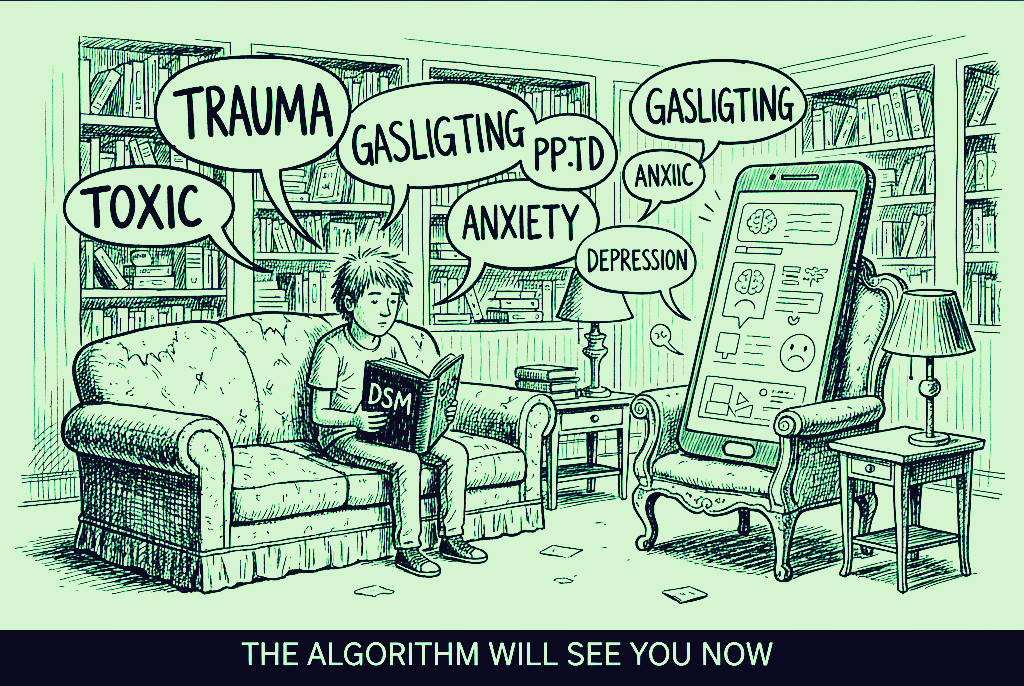
We are doing it again.
Every generation looks at the damage their parents did, swears blind they’ll do the opposite, and over-corrects so hard they invent an entirely new disaster. It’s a pattern as old as parenting itself. And right now, we’re watching it play out in real-time with the most “mentally health aware” generation in history — who also happen to be the most miserable one on record.
This isn’t sensationalism. The numbers are right there. And they don’t add up the way you’d expect.
The Bit That Doesn’t Sit Right
I went down this rabbit hole after finding out my 11 and 13-year-old niece and nephew instantly recognised Last Resort by Papa Roach. Not just recognised it — they stream it. The song’s numbers have absolutely spiked among under-18s in the last couple of years. Great song, loved it, but it wasn’t even fully mainstream when it came out. So why are kids in 2026 gravitating to the raw scream-along angst of early 2000s nu-metal?
That question pulled me into the data on youth suicide, and what I found genuinely shocked me.
I assumed — like most people my age probably would — that suicide rates among young people were higher in the 80s and 90s. Kurt Cobain blew his head off. Every other song was about wanting to die. The vibes were objectively grim.
But the data tells a completely different story.
I. The Cold Hard Data
Before we get to the theory, we have to look at the reality. The numbers don’t lie, and they paint a picture of a generation under siege from multiple angles simultaneously.
The Suicide “U-Turn”
For decades, we were winning. Between 1990 and 2007, youth suicide rates plummeted. We improved depression identification, reduced firearm access, and things looked hopeful. Then, around 2007, the trend reversed — hard.
The decline from 1990 to 2007 was a genuine public health success story — a 25% reduction driven by better screening, crisis lines, and reduced access to lethal means. Then the iPhone launched. Facebook went mainstream. And the curve bent back upward with sickening speed.
The rate among Black youth aged 10–17 increased by 144% between 2007 and 2020. Suicide became the 2nd leading cause of death for high school students. We’re now in what researchers call a “High Plateau” — the explosion has levelled off, but at a catastrophic historic high. We haven’t fixed it. We’ve just stopped being surprised by it.
The Violence of Exposure
School shootings themselves are statistically rare as a cause of death. But the exposure to them is now universal — and that matters psychologically.
The stat that hits hardest: 3 million children are exposed to some form of gunfire at or near school annually. We’ve gone from fire drills (predictable, routine) to active shooter drills (existential, traumatising). School stopped being a “safe space” in any meaningful sense.
The “No Escape” Factor
In 1980, bullying stopped when the bell rang. Your home was your fortress. In-person bullying has actually stayed flat — about 19–20% of students, roughly the same as 2011. The nature of bullying is what changed.
The "No Escape" Shift
1980s
Bullying ended when the bell rang. Home was a fortress. You could escape.
2026
The bully is in your pocket. 33% cyberbullied in the last 30 days alone. No escape.
Digital Saturation
The shift from offline to perpetually online happened at a speed nobody was ready for.
That’s not “using a tool.” That’s living inside one.
II. The Generational Pendulum
Here’s where it gets uncomfortable. Because to understand why we’re here, you have to look at the emotional inheritance we keep passing down — and how each generation’s “fix” creates the next generation’s problem.
The War Generation (Grandparents) — Emotionally distant fathers, often scarred by war. Mothers trapped in domestic frustration with no language for what they were feeling. Parenting philosophy: don’t beat them too hard and you’re doing alright.
Result: They raised children who felt unsafe and emotionally abandoned.
The Boomers (Born 1950s–60s) — My mum’s generation. They took the full weight of that “hard” parenting. The classic cocktail — narcissistic, emotionally manipulative mothers; distant, often alcoholic fathers. They grew up without the words for what happened to them, but they felt it.
The Vow: “I will never do that to my kids.”
The Millennials (Born 1980s–90s) — The Self-Esteem Experiment — This is us. Our parents didn’t just try to be better — they went all in. This was the era of the Self-Esteem Movement of the late 80s and 90s: participation trophies, constant affirmation, helicopter parenting on steroids. They were trying to heal their own inner child by over-inflating ours.
Result: We grew up anxious but “special.” We were the first generation to really start talking about therapy.
Gen Z / Alpha (Born 2000s–2010s) — The Therapy-Tok Era — And now it’s our turn. We dealt with our stuff. We went to therapy. We learned the language. And we thought: this is what was missing. If we just make kids aware of mental health earlier, they’ll be fine.
The Over-Correction: We force-fed “mental health awareness” to kids via the same devices they’re addicted to — devices we didn’t grow up with, so we fundamentally don’t understand what it’s like to be truly online 24/7.
We gave them the vocabulary of a psychiatrist and a smartphone, but we didn't give them the resilience to handle either.
Sidebar: The Soviet Delay
This generational pendulum isn’t universal — it’s geopolitical. There’s strong anecdotal (and some academic) evidence that in the former Soviet Union, this entire cycle is delayed by roughly one generation.
While the West was deep in helicopter parenting and self-esteem culture in the 90s, the Soviet bloc was still culturally frozen. The luxury of emotional introspection simply didn’t exist.
The Geopolitical Time Lag
Girl born 1988 — West
Told she was special. Helicopter parented. Self-esteem movement in full swing.
Girl born 1988 — Former USSR
Experiencing the same emotionally distant, hard-nosed upbringing my mother had in 1950s Britain.
The “toxic mother / distant father” dynamic didn’t die out — it just moved East. We’re watching two tragedies unfold simultaneously: the West suffering from too much therapy-speak, the East still reeling from the total absence of it.
III. The Openness Paradox
This is the part that breaks your brain.
They have the language. They don’t have the cure.
And here’s the thing nobody wants to say out loud: some of that “awareness” is making things worse.
If you don’t know the word “trauma,” you can’t report on a survey that you’ve experienced trauma. Increased awareness inevitably means increased reporting. That accounts for some of the rise. But it doesn’t account for all of it — not by a long shot. You don’t get a 62% increase in actual deaths from reporting bias alone.
IV. The Therapy-Tok Trap
Here’s my working theory, and it’s backed by the 2025/2026 data:
Someone who thinks they know about therapy is potentially worse off than someone with no therapy at all.
What we’re seeing is not a generation that’s more “mental health aware.” It’s a negative social media feedback loop that is actively harmful.
The Therapy-Tok Cycle
Step 1: Normal sadness
A breakup, a bad grade, a fight with a friend. The stuff that has always been part of adolescence.
Step 2: The algorithm kicks in
TikTok serves "10 signs you have Complex PTSD." Instagram shows an infographic about "trauma responses."
Step 3: Label adoption
Normal sadness gets reframed as a clinical condition. It becomes an identity, not an emotion.
Step 4: Stagnation
Instead of processing and moving on, they "sit with it" and scroll for more content confirming their diagnosis.
We’ve pathologised the human experience. Every bad day is “depression.” Every disagreement is “gaslighting.” Every breakup is “trauma.” And the algorithm is only too happy to keep feeding that narrative.
We gave the youth a medical textbook but no doctor. They didn't get treatment. They got convinced they have every disease in the book.
V. The Papa Roach Theory: Catharsis vs. Analysis
This brings us back to Last Resort and why 13-year-olds are streaming nu-metal in 2026.
The 90s/00s offered catharsis. When Kurt screamed, when Papa Roach sang about cutting their life into pieces — it was a communal vent. You put on the CD, you screamed along in your bedroom, you felt the rage, and you let it go. It was externalised. It was temporary. It was release.
2026 offers analysis. We don’t teach kids to scream it out. We teach them to “sit with it.” To “examine their attachment style.” To “identify the trigger.” We’ve replaced the raw release of emotion with the clinical dissection of it.
Catharsis vs. Analysis
Then (1990s–2000s)
Feel bad → put on music → scream → catharsis → move on. Emotional release was externalised and temporary.
Now (2020s)
Feel bad → algorithm serves diagnosis → adopt label → "sit with it" → scroll more. Distress is internalised and permanent.
The result? Kids aren’t getting the relief of a scream. They’re getting the anxiety of a diagnosis.
The spike in nu-metal streaming isn’t nostalgia — these kids weren’t alive for the original run. It’s a search for the raw, unpolished emotional intensity that therapy-speak has sanitised out of their world.
We Missed the Boat
We can’t just blame phones and social media. That’s lazy, and it’s too late anyway. The mistake happened a decade ago when we handed over the devices without teaching the hygiene of how to use them. We missed the window, then panicked and tried to ban what we didn’t understand.
We can’t just blame “a lack of awareness.” There’s never been more awareness. That’s the whole problem.
We tried to be better than our parents. We tried to be open. We tried to give kids the emotional vocabulary we never had. And in doing so, we created a culture where normal human struggle gets treated as a medical emergency — and the only doctor available is an algorithm optimised for engagement, not recovery.
The Bottom Line
Maybe it's time we stopped analysing our kids' happiness to death.
Maybe we let them scream along to something loud, go outside, and remember that being a teenager was always supposed to be a bit shit — and that's not a disorder.
That's just being alive.
If you or someone you know is struggling, the 988 Suicide & Crisis Lifeline is available 24/7 in the US by calling or texting 988. In the UK, contact the Samaritans on 116 123.
This post was inspired by a rabbit hole that started with Papa Roach and ended somewhere between CDC data and a theory about the Soviet Union. Data referenced from CDC YRBS surveys, Pew Research, and publicly available school safety incident tracking. The opinions — and the over-corrections — are my own.