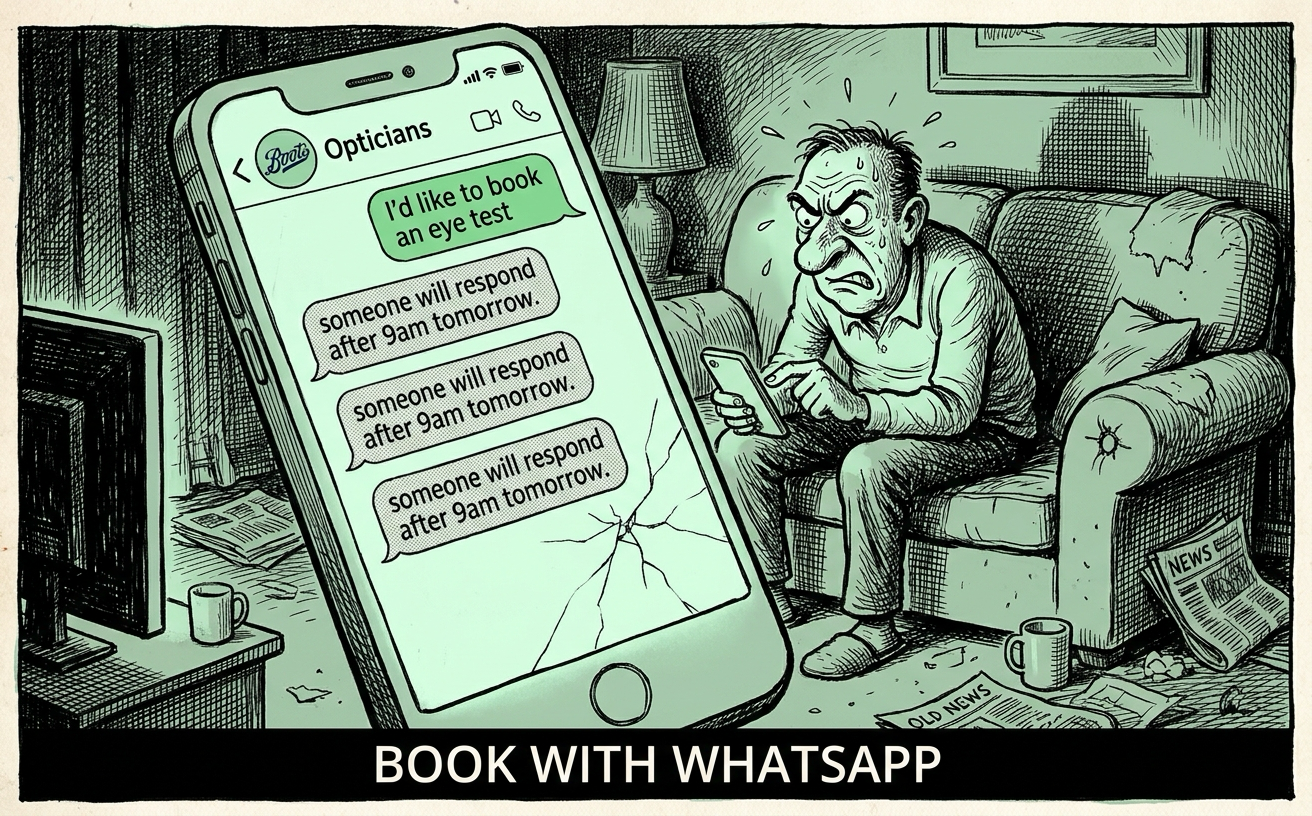
I hate booking eye tests.
Not the test itself — the booking. The phoning up. The hold music. The being told there’s nothing until the second Tuesday of never, at 2:15pm, which is the one slot in the calendar that clashes with your entire life. It is a small, stupid friction, and I will do almost anything to avoid it.
So when I landed on the Boots Opticians site and saw a big green button that said Book with WhatsApp — reader, I was delighted. Finally. A company reading my mind. No phone call. No hold music. Just a quick message like a normal human in 2026.
I tapped it. And that is where the story gets good.
”Book with WhatsApp”
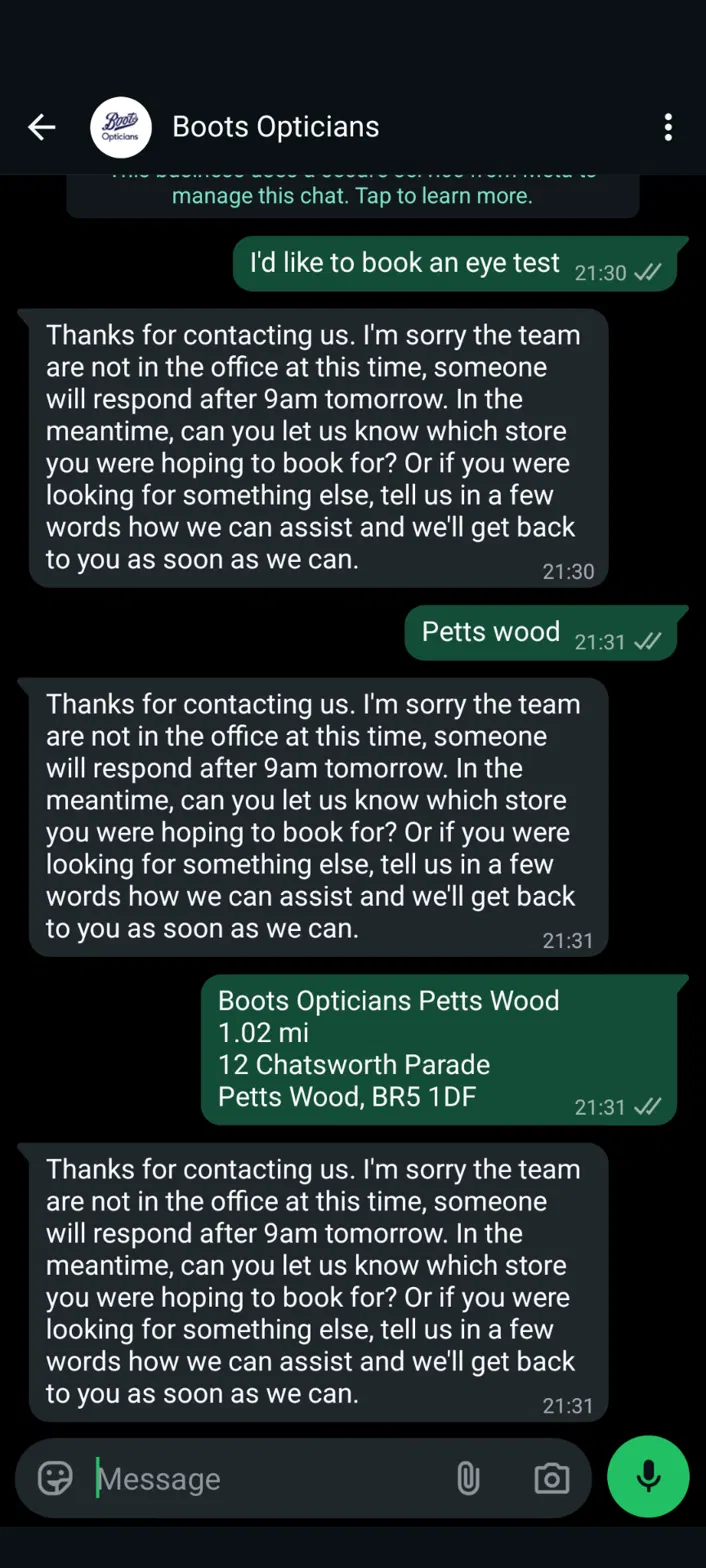
Here’s the full, unedited transcript of the great WhatsApp booking revolution.
Me: I’d like to book an eye test.
Boots: Thanks for contacting us. I’m sorry the team are not in the office at this time, someone will respond after 9am tomorrow. In the meantime, can you let us know which store you were hoping to book for?
Fair enough. It’s late. So I tell it the store.
Me: Petts Wood.
Boots: Thanks for contacting us. I’m sorry the team are not in the office at this time, someone will respond after 9am tomorrow. In the meantime, can you let us know which store you were hoping to book for?
The exact same message. Word for word. So I get generous. Maybe it wants the specific branch. I send it the whole thing — name, address, postcode, the lot, formatted like a business card.
Me: Boots Opticians Petts Wood, 12 Chatsworth Parade, Petts Wood, BR5 1DF.
Boots: Thanks for contacting us. I’m sorry the team are not in the office at this time, someone will respond after 9am tomorrow. In the meantime, can you let us know which store you were hoping to book for?
Three times. Identical. A little green groundhog day.
What Actually Happened Here
Let me put my making-tech-legible hat on for a second, because this bit matters.
That was not a bot. It was not “AI.” It wasn’t even a particularly clever bit of software. What I was talking to is a WhatsApp auto-reply — the corporate equivalent of an out-of-office. It fires the same canned line at every inbound message, because it isn’t reading the messages. It can’t. There’s no parsing, no intent, no memory of the sentence I sent nine seconds earlier. It asks “which store?”, I answer, and it asks “which store?” again — because the question was never really a question. It was wallpaper.
Which would be completely fine — an away-message is an honest, humble little tool — if the button hadn’t promised me a booking. “Book with WhatsApp” is not “leave a message and we’ll get back to you.” It’s a promise of a transaction. What was delivered was an answering machine that repeats itself.
And the punchline? On the very same page, in the very same session, the site cheerfully told me the next available appointment: Saturday, 1 August, 10:30am. The information existed. It was right there. The one route to it, apparently, was the phone call I’d been trying to avoid — the analogue thing, the thing that works.
So I Went Down a Rabbit Hole
At this point I did what any reasonable, mildly petty person does. I thought: how big is this company, that it can’t wire up a WhatsApp booking? Surely it’s a plucky little chain, stretched thin.
Reader, it is not.
The Boots Group runs 3,912 shops around the world. It employs 66,400 people. It turns over $23.6 billion a year. It has shops across the UK, Ireland, Germany, Mexico and Thailand, holds retail investments in China, and runs franchises from the Middle East to Indonesia. In the UK alone it sits on the data of 16.9 million active Advantage Card members — one of the richest loyalty datasets in British retail.
This is not a company that lacks resources. This is a company that could commission a functioning booking bot the way you or I might order a coffee.
So why the answering machine?
III. The Transformation-Industrial Complex
Here’s where it stops being funny and starts being interesting.
Because when I went looking for evidence that Boots is a sleepy laggard asleep at the digital wheel — I found the opposite. I found a company absolutely drowning in the language of transformation. There is, it turns out, an entire cottage industry of executives, PR teams and trade-press journalists whose job is to tell each other, at length, how thoroughly Boots is being revolutionised by AI.
The chief digital officer has been on the record about the company’s “biggest ever digital transformation.” About a brand-new platform that will revolutionise the online offer and deliver “seamless, personalised omnichannel service.” About the virtues of a composable architecture — which, decoded from consultant into English, mostly means “we can change bits of the website without rebuilding the whole thing.” Reasonable! Sensible, even. Also: not magic.
The trade press laps it up. There are interviews about Boots taking a “purpose-led approach” to AI and data. There are round-ups anointing it one of the retailers leading the way on adoption. And there is my favourite sentence in the entire genre, delivered by the same chief digital officer to Retail Week, which I am going to frame and hang above my desk:
I honestly think AI is going to be completely transformative.
I honestly think, madam, that it has not yet transformed the WhatsApp button.
None of these quotes are lies, exactly. That’s the tell. This is the native dialect of modern corporate life — a fluent, frictionless language of “journeys” and “touchpoints” and “unrivalled product ranges” that has almost no contact with the surface where a customer actually stands, thumb hovering over a green button, trying to book a bloody eye test. The words are pointed at the industry. Not at me.
IV. The AI Is Real. Look Where They Aimed It.
And now the bit that should genuinely make you sit up, because the lazy version of this story is “big company can’t do AI, ha ha.” That’s not it. That’s not it at all.
Boots can do AI. It’s deployed plenty.
It brought in a specialist AI platform — Ocula’s “Boost” — for a very specific, very telling job: hunting down abandoned shopping carts. The tech analyses the site to work out where shoppers are dropping off, ranks the fixes by predicted value, and points the team at whatever will recover the most revenue. And it works: around the deployment, Boots.com posted a 28.9% jump in sales over the quarter and clocked its tenth consecutive quarter of market-share growth.
So let’s be precise about what’s happening. The AI isn’t missing. It’s present, funded, and sharp — and it has been aimed, with total clarity of purpose, at the part of the business that extracts money from you. Every ounce of machine intelligence went to conversion. None of it went to the tedious, unglamorous, human bit where you’re simply trying to ask for something.
They have spent more, and thought harder, about the cart you abandon than the appointment you're desperate to book. The AI isn't broken. It's just pointed at your wallet, not your eyes.
That’s the story. Not incompetence — priorities. The abandoned-cart bot exists because someone could draw a straight line from it to the P&L. The booking bot is an answering machine because “customer successfully books eye test, feels calm, tells no one” doesn’t show up on a dashboard with a pound sign next to it.
The AI is a mirror. It reflects, with brutal honesty, exactly what the company values. And it turns out the company values your basket rather more than your retina.
We Missed the Button
There is a hopeful version of this piece — the CDO herself gestures at it, citing the great virtue of that composable setup as “the power of adaptability.”
Terrific. Genuinely. So here is the adaptability I’d like to see: adapt to a person typing “I’d like to book an eye test” into the box under the button that says book. That’s the whole ask. Not a revolution. Not a transformation. Not a seamless personalised omnichannel journey across all touchpoints. Just a bot that reads the second message differently from the first.
Because that’s the quiet scandal underneath all of this. It was never that Boots is too small, too poor, or too analogue to build the thing. It’s that a $23.6-billion company with 16.9 million loyalty profiles and a chief digital officer who thinks AI will be completely transformative looked at the gap between the press release and the green button — and decided the press release was the part worth funding.
The Eye Test
We're heading into a decade where every company will tell you it's been remade by AI. Most of them will mean it.
The test — the eye test — isn't whether they can say the words. It's whether, when you type a plain human sentence into a box, anything on the other end is actually listening.
Right now, at Boots, someone will respond after 9am tomorrow.
This one started with a green button and ended somewhere between a Wikipedia infobox and a very fluent quote in a trade magazine. Boots’ scale (3,912 shops, 66,400 staff, $23.6bn sales, 16.9m Advantage Card members) is drawn from The Boots Group’s own corporate reporting; the Ocula “Boost” abandoned-cart deployment and the 28.9% quarterly sales rise from Ocula Technologies’ own case study; the “completely transformative” and “purpose-led” quotes from Chief Digital Officer Paula Bobbett, speaking to Retail Week (2026) and InternetRetailing (2025). The transcript is real. The eye test is, as of writing, still unbooked. The opinions — and the pettiness — are my own.