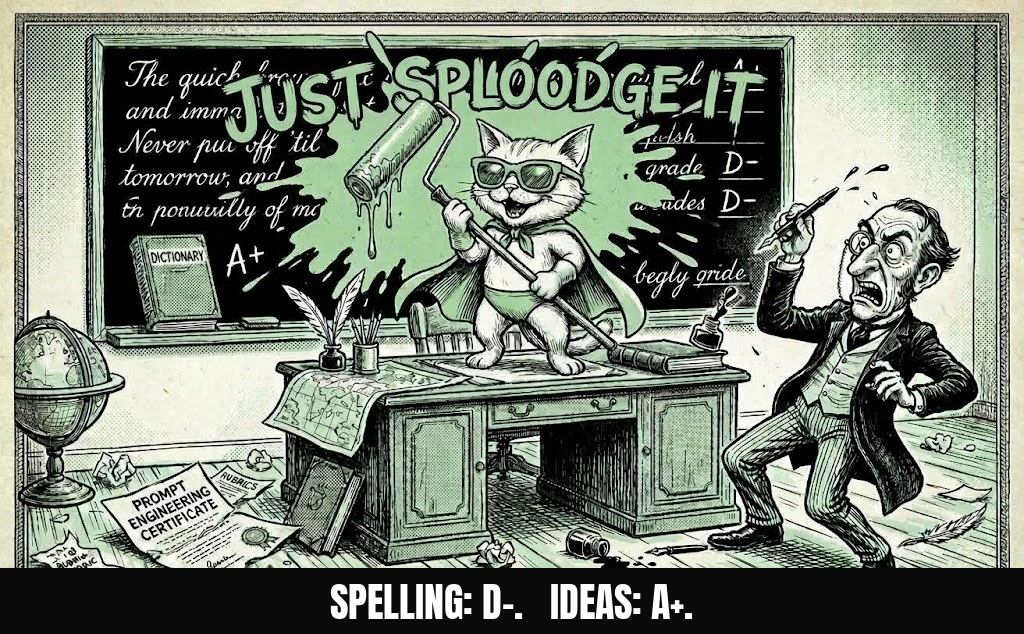
The entire creative brief for the FlexOS launch promo was one sentence, and it was not a good sentence.
Claude took this extremely literally and went off to price sound effects, on the reasonable grounds that “boom boom” needs sound. So I clarified, with all the precision of a man typing on his phone:
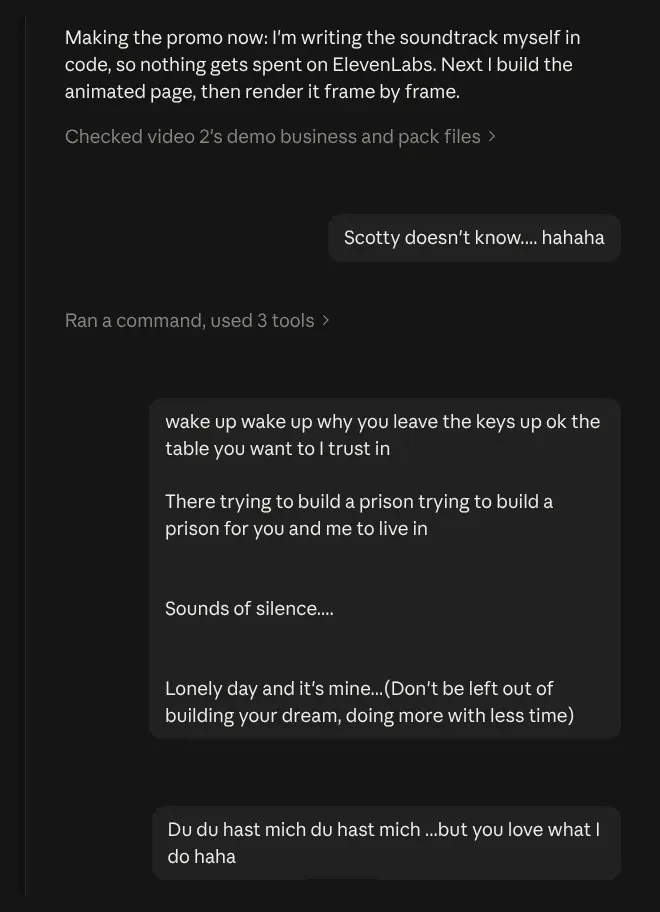
That was the brief. No deck, no mood board, no shot list, and no idea what a bookb is. Once it was rolling I heckled from the sidelines with half-remembered nu-metal lyrics, which it took in its stride while writing its own soundtrack in code.
What came back is thirty seconds long. It opens on a question (what stops you getting found on Google?), answers it in minutes, clocks the people arriving from Lovable clutching a GitHub zip called muddy-paws-main.zip, offers three free days, and lands on a caped cat in green sunglasses standing next to flexos.me. Somewhere in the middle the same cat, armed with a paint roller, announces NO CREDITS PER MESSAGE. Nothing counted. It is fast, loud, mildly epilepsy-inspiring, nonsensical and non-readable, and yet objectively very polished. It looks like an agency invoiced somebody twenty grand for it.
The peer review was rigorous. It cleared my mum (rave), my friends (rave), the people I spam relentlessly on WhatsApp (held hostage; also a rave) and the only critics who pay rent, the YouTube Shorts analytics. The views will not trouble MrBeast. On Shorts, though, the number that counts is whether people stay, and this one averages 120% watch time: people watched it, then watched it again. For the first time on anything I’ve posted, there was no 90%-gone-by-second-two cliff. For the two-second attention spans of 2026, that’s a standing ovation.
I’m dogmatic about precisely one thing when it comes to AI, and I will die on this hill wearing novelty sunglasses: you do not need a course. You don’t need a degree, a certificate, a bootcamp or a prompt engineer. The secret to wow-factor work is to be as unapologetically you as you can manage, your dark, crazy, intrusive, but-you-can’t-say-that thoughts included, and press enter. There is one piece of small print, and I’ll get to it.
The Toll Booth on a Free Road
There’s a whole economy built to convince you the road to wow is gated. A cohort here. A “Prompt Engineering Certification” there. A LinkedIn guru insisting you master the Seventeen Immutable Laws of Context Windows before you’re allowed to make anything good. It’s a toll booth bolted onto an open road, and the barrier is made of cardboard.
Most people have already driven straight through it. Microsoft and LinkedIn’s 2024 Work Trend Index found that 75% of knowledge workers use AI at work, 78% of them with tools they brought themselves, and only 39% have had any AI training from their employer. Nobody issued them anything. They learned it the way you learn a kitchen: by making a mess in it.
The toll collectors didn’t last long either. In 2023 “prompt engineer” was billed as the hottest job in tech, and courses promised anyone who learned the incantations a quick route to a high-paying one. By 2025 the Wall Street Journal was calling the role obsolete. In a Microsoft survey of 31,000 workers across 31 countries, it ranked second-to-last among the new roles companies were considering. The models got good enough at working out what you meant, and the certificate expired before the ink was dry.
The Jamie Oliver School of Prompting
Cookery used to mean a recipe: exact quantities, in grams, in order, and woe betide anyone who deviated. Then, in 1999, The Naked Chef turned up on BBC Two with a young chef who didn’t seem to measure anything. A glug of olive oil. A handful of this. Bish, bash, bosh. The recipe-followers were appalled. The food was better, because it was confident and it was his.
AI is still in its recipe era. The courses teach Act as a world-class [role]. Your task is [task]. Your audience is [audience]. Tone: [tone]. Prompt libraries run to thousands of entries, and the frameworks come with acronyms. It’s a form with ambitions.
The Recipe vs. The Sploodge
The recipe (what the courses teach)
"Act as a world-class video producer. Create an energetic 30-second launch promo for [product], targeting [audience]. Tone: upbeat but professional. Include a clear call to action. Avoid clichés."
The sploodge (what actually shipped)
"less 'accurate UX recording' more boom boom wow pow use it do this cut cut quick quick wowza style" — followed by "I just meant punch hype up launch promo style".
The model already has the polish. It knows grammar, pacing, colour theory, how a promo is cut and what a call to action looks like, and it has read more of all that than any of us ever will. What it hasn’t got is you: your taste, your mood, the odd reference that makes the thing yours. A tidy, corporate-voiced prompt spends its words on the part the machine already knows. Boom boom wow pow told it more about tempo and attitude than energetic, upbeat but professional ever could.
The mess is the signal. The polish is where you leak.
The mess is also easier to make when nobody’s watching. Every room most of us work in charges a tax on ideas. You circle back to what Janet said. You build off that great insight Tom just shared. You sand your thought down until it’s safe to say out loud, and by then it’s beige. The machine charges no such tax. So don’t splurge, don’t architect, don’t engineer, caveat, compose or construe. My dear reader: just sploodge it all over the place. The messier the better; the more typos, the who-cares. No grammar, no punctuation, not a complete sentence to be seen for miles. Shove in some screenshots, or a picture of a cat for flavour. Then press enter.
But It’s All AI Slop
The best study we have on this backs the sploodge, then complicates it. In 2024 Anil Doshi and Oliver Hauser had 293 writers produce short stories, some with AI-generated ideas to hand, and 600 people judged the results. With five AI ideas, stories were rated 8.1% more novel and 9% more useful. The gains went mostly to the writers who had scored least creative beforehand (10.7% and 11.5%), which pulled them level with the most creative writers in the study. The tool rewards the person who has an idea and no technique to sand it down with.
The complication is in the same paper. The AI-assisted stories were more similar to each other than the human-only ones: each writer did better, and the pool as a whole got narrower. A language model is an averaging machine, and if you feed it the average you get the beige median of the internet back. That’s where “AI isn’t creative” comes from, and it’s a fair description of most feeds in 2026: the same glossy faces, the same captions, the same in today’s fast-paced world.
Look at what goes in, though. The output goes beige when the input is beige. When everyone types the same polite, well-structured, recipe-card prompt, the machine has nothing to work from but its own average. It can’t average away an input it has never seen, and it’s a safe bet nobody else has ever briefed one with boom boom wow pow and then insisted they didn’t mean it literally.
AI isn't uncreative. Beige prompts are.
The Small Print
The sploodge has small print, and it’s only fair to read it out.
The promo didn’t come from nowhere. Boom boom wow pow landed in a session already up to its elbows in FlexOS: the product, the docs, the brand colours and the caped cat, who is the brand. The mess worked because the context was already there. This post is the same. The wall of text you’ll meet at the end went into a project that already holds a house style guide, a fact sheet about me and a dozen previous posts to learn my voice from. Learning from only a dozen has one side effect: it picked up a few of my favourite transitions and now deploys them with the zeal of a convert. I can no longer read some of them without hearing nails down a chalkboard.
You don’t need a course for any of that. You need context, and you already have it: your notes, your brand, the three things you’ve made that you’re proud of, screenshots of the stuff you love. So the method is almost insultingly small. Give it your world, then make a mess on top of it. Don’t write a prompt. Don’t open the template. Don’t Google “best prompts for video”. Type the thing the way it sounds in your head, the reference only you would make and the joke you’d never say in the meeting, and press enter. Just don’t try to do it like a developer, and you’ll have a blast.
Meanwhile, in Double Maths
The people who are least edited of all, and most punished for it, are kids, and they’ve already decided. Pew Research’s latest survey of US teenagers, taken in the autumn of 2025, found that 64% use AI chatbots and 54% have used them for help with schoolwork. One in ten do all or most of their schoolwork with a chatbot’s help. Only about half of their parents think they use chatbots at all.
At university it’s close to universal. In the Higher Education Policy Institute’s annual survey of UK undergraduates, AI use went from 66% in 2024 to 92% in 2025 and 95% in 2026. Using it for assessed work went from 53% to 88% to 94%.
The institutional response to a generation teaching itself the one future-proof skill on the table has been to ban it, detect it and punish it. The detectors aren’t up to the job. In 2023 a Stanford team (Weixin Liang, James Zou and colleagues) ran seven popular GPT detectors over human-written essays. On average they flagged 61% of TOEFL essays by non-native English speakers as AI-generated, and 97.8% were flagged by at least one detector. On essays by US eighth-graders they were near-perfect. The machine meant to catch cheats is far better at catching people writing carefully in their second language.
There’s a real cost on the other side, and it deserves its say: if the machine writes the essay, the child didn’t learn to write the essay. Granted. But look at what they are learning, entirely of their own accord: how to direct a machine, how to tell good output from bad, how to throw an idea at a wall and keep what sticks. The same Work Trend Index found that two-thirds of business leaders wouldn’t hire someone without AI skills. We are not disqualifying cheaters. We are disqualifying the self-taught.
Hold that thought. Every time someone says “it’s just AI”, or “AI isn’t creative”, or marks a kid down for using it, park it here. We’ll be back for it.
Epilogue: The Reveal
You’ve just read a tidy, illustrated, fact-checked blog post, with charts, sources, pull quotes and a caped cat. Here, unedited, is what I typed to get it:
The wall of text, copied exactly. Every typo is original — here’s the screenshot, for the doubters.
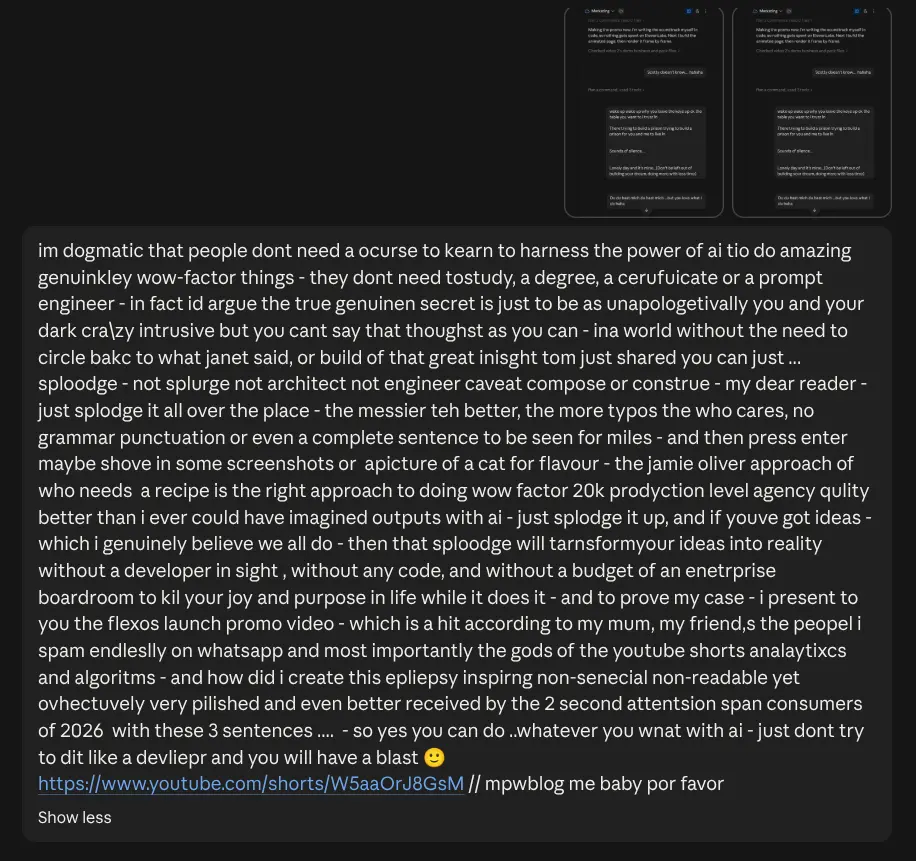
And then, because a wall of text apparently wasn’t enough, the follow-up that ordered the section you’re reading now:
No outline. No second draft. No circling back to what Janet said. The machine had the style guide and did the typing. The ideas were already in there, intact inside the mess. The creativity was never in the spelling.
Now unpark that thought. Welcome to the sploodge.
The Bottom Line
The next time someone tells you AI isn't creative, or that using it is cheating, or punishes your child for using it on their homework (defeating the one useful skill they're picking up of their own accord), remember the wall of typos that made the thing you just read.
The skill was never the grammar. It was the nerve to make a mess and press enter.
For my mum, with love
Who, when I was small, would sit down and translate my school submissions — not correct them, translate them — so my teacher could actually read what I'd written. No rubric. No penmanship grade. No red pen demanding the letters stand up straight, the words match the dictionary with nary a one left out, and absolutely nothing scrawled sideways in a circle. She just worked out what I meant, and made sure it reached the page intact.
Three failed handwriting grades she quietly alchemised into unshakeable — some would say delusional — self-belief, with a line I've carried ever since:
"Doctors can't write either. And when you're famous, you'll have someone to edit your books for you."
Without her humour, her genetics and her generous re-rating of my Pulitzer-quality scribbles, there'd be no writer here to sploodge anything at all. Turns out she was the editor — and the believer — all along.
For that, and for everything since: thank you, Mum.
Exhibit A is the FlexOS launch promo, which lives at flexos.me. Data referenced from the Microsoft and LinkedIn 2024 Work Trend Index; the Wall Street Journal (2025) on the prompt-engineer role, citing Microsoft’s survey of 31,000 workers in 31 countries; Doshi & Hauser, “Generative AI enhances individual creativity but reduces the collective diversity of novel content”, Science Advances (2024); Pew Research Center, “How Teens Use and View AI” (February 2026; fieldwork September–October 2025, 1,458 US teens); the HEPI/Kortext Student Generative AI Surveys (2024, 2025 and 2026); and Liang et al., “GPT detectors are biased against non-native English writers”, Patterns (2023). Watch-time figures are from YouTube Studio. The opinions — and the typos in the epilogue — are my own.